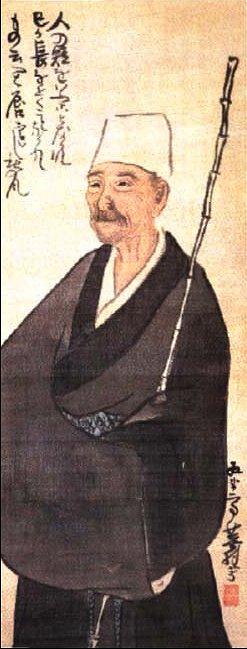
Macuo Bašó: Citáty anglicky
見るところ花にあらずと云ふことなし、<br>思ふところ月にあらずと云ふことなし。 <br class="br">Miru tokoro hana ni arazu to iu koto nashi,<br>omou tokoro tsuki ni arazu to iu koto nashi <br class="br">Classical Japanese Database, Translation #172 http://carlsensei.com/classical/index.php/translation/view/172 (Translation: Reginald Horace Blyth) <br class="br">Statements <br class="br">Varianta: There is nothing you can see that is not a flower;<br>There is nothing you can think that is not the moon.
Matsuo Bashō, Collected Haiku Theory, eds. T. Komiya & S. Yokozawa, Iwanami, 1951 (Unknown translator)
Statements
“How still it is!
Stinging into the stones,
The locusts' trill.”
Bashō Matsuo kniha Oku no Hosomichi
静けさや
岩に滲み入る
蝉の声
shizukesaya
iwa ni shimiiru
semi no koe
Donald Keene, World Within Walls: Japanese Literature of the Pre-Modern Era, 1600-1867, New York, 1999, p. 89 (Translation: Donald Keene)
Oku no Hosomichi
“The summer grasses—
For many brave warriors
The aftermath of dreams.”
Bashō Matsuo kniha Oku no Hosomichi
夏草や<br>兵どもが<br>夢の跡 <br class="br">natsukusa ya<br>tsuwamonodomo ga<br>yume no ato <br class="br">Donald Keene, Travelers of a Hundred Ages, New York, 1999, p. 316 (Translation: Donald Keene) <br class="br">The summer grasses—<br>Of brave soldiers' dreams<br>The aftermath. <br class="br">Matsuo Bashō, The Narrow Road to Oku, Tokyo, 1996, p. 87 (Translation: Donald Keene) <br class="br">Also: Classical Japanese Database, Translation #222 http://carlsensei.com/classical/index.php/translation/view/222 <br class="br">Oku no Hosomichi
“kojin no ato wo motomezu,
kojin no motometaru no tokoro wo motome yo”
Seek not the paths of the ancients;
Seek that which the ancients sought.
from 「柴門の辞」"Words by a Brushwood Gate" (also translated as "The Rustic Gate") (Unknown translator)
Statements
“Bird of time –
in Kyoto, pining
for Kyoto.”
Basho, On Love and Barley: Haiku of Basho, London, 1985, p. 43 (Translation: Lucien Stryk) <br class="br">Even in Kyōto&mdash;<br>hearing the cuckoo's cry&mdash;<br>I long for Kyōto<br>Classical Japanese Database, Translation #55 http://carlsensei.com/classical/index.php/translation/view/55 (Translation: Robert Hass) <br class="br">Individual poems
“I shall be unhappy without loneliness.”
Classical Japanese Database, Translation #41 http://carlsensei.com/classical/index.php/translation/view/41 of a Saga Diary excerpt (Translation: Robert Hass) <br class="br">Statements
sabi wa ku no iro nari. kanjaku naru ku wo iu ni arazu. tatoeba, roujin no katchuu wo taishi senjou ni hataraki, kinshuu wo kazari goen ni haberitemo, oi no sugata aru ga gotoshi. <br class="br">Classical Japanese Database, Translation #42 http://carlsensei.com/classical/index.php/translation/view/42 (Translation: Robert Hass) <br class="br">Statements
“Spring passes
and the birds cry out—tears
in the eyes of fishes”
Bashō Matsuo kniha Oku no Hosomichi
行く春や
鳥啼き魚の
目は泪
yuku haru ya
tori naki uo no
me wa namida
Matsuo Bashō, Narrow Road to the Interior and other writings, Boston, 2000, p. 4 (Translation: Sam Hamill)
Spring is passing by!
Birds are weeping and the eyes
Of fish fill with tears.
Matsuo Bashō, The Narrow Road to Oku, Tokyo, 1996, p. 23 (Translation: Donald Keene)
The passing of spring—
The birds weep and in the eyes
Of fish there are tears.
Donald Keene, Travelers of a Hundred Ages, New York, 1999, p. 310 (Translation: Donald Keene)
Oku no Hosomichi
“Soon to die
yet showing no sign
the cicada's voice”
やがてしぬ<br>けしきはみえず<br>蝉の声 <br class="br"> https://haikutopics.blogspot.ca/2006/07/voice-of-animal-xx-no-koe.html https://www.tofugu.com/japan/japanese-poetry-crash-course/ <br class="br">Individual poems
Matsuo Bashō, Collected Haiku Theory, eds. T. Komiya & S. Yokozawa, Iwanami, 1951 (Unknown translator)
Statements
“The old pond:
A frog jumps in,—
The sound of the water.”
Bashō Matsuo Frog Poem
古池や<br>蛙飛び込む<br>水の音 <br class="br">furu ike ya<br>kawazu tobikomu<br>mizu no oto <br class="br">Classical Japanese Database, Translation #64 http://carlsensei.com/classical/index.php/translation/view/64 (Translation: Reginald Horace Blyth) <br class="br">At the ancient pond<br>the frog plunges into<br>the sound of water <br class="br">Translation: Sam Hamill <br class="br">Old pond,<br>leap-splash &ndash;<br>a frog. <br class="br">Basho, On Love and Barley: Haiku of Basho, London, 1985, p. 58 (Translation: Lucien Stryk) <br class="br">Breaking the silence<br>Of an ancient pond,<br>A frog jumped into water &ndash;<br>A deep resonance. <br class="br">Matsuo Bashō, The Narrow Road to the Deep North and Other Travel Sketches, London, 1966, p. 9 (Translation: Nobuyuki Yuasa) <br class="br">Individual poems
“Sick on a journey,
my dreams wander
the withered fields.”
旅に病で
夢は枯野を
かけ廻る
tabi ni yande
yume wa kareno wo
kake-meguru
Bashō's last poem, written while he was dying of a stomach illness. (Translation: Robert Hass)
Sick on a journey –
over parched fields
dreams wander on.
Basho, On Love and Barley: Haiku of Basho, London, 1985, p. 81 (Translation: Lucien Stryk)
Travelling, sick
My dreams roam
On a withered moor.
Unknown translator
Individual poems
“I am that one person
Who eats his breakfast,
Gazing at morning nothing.”
Classical Japanese Database, Translation #174 http://carlsensei.com/classical/index.php/translation/view/174 (Translation: Reginald Horace Blyth) <br class="br">Individual poems <br class="br">Originál: (ja) 朝顔に<br>我は飯食ふ<br>男かな <br class="br">Originál: (ja) asagao ni<br>ware wa meshi kû<br>otoko kana