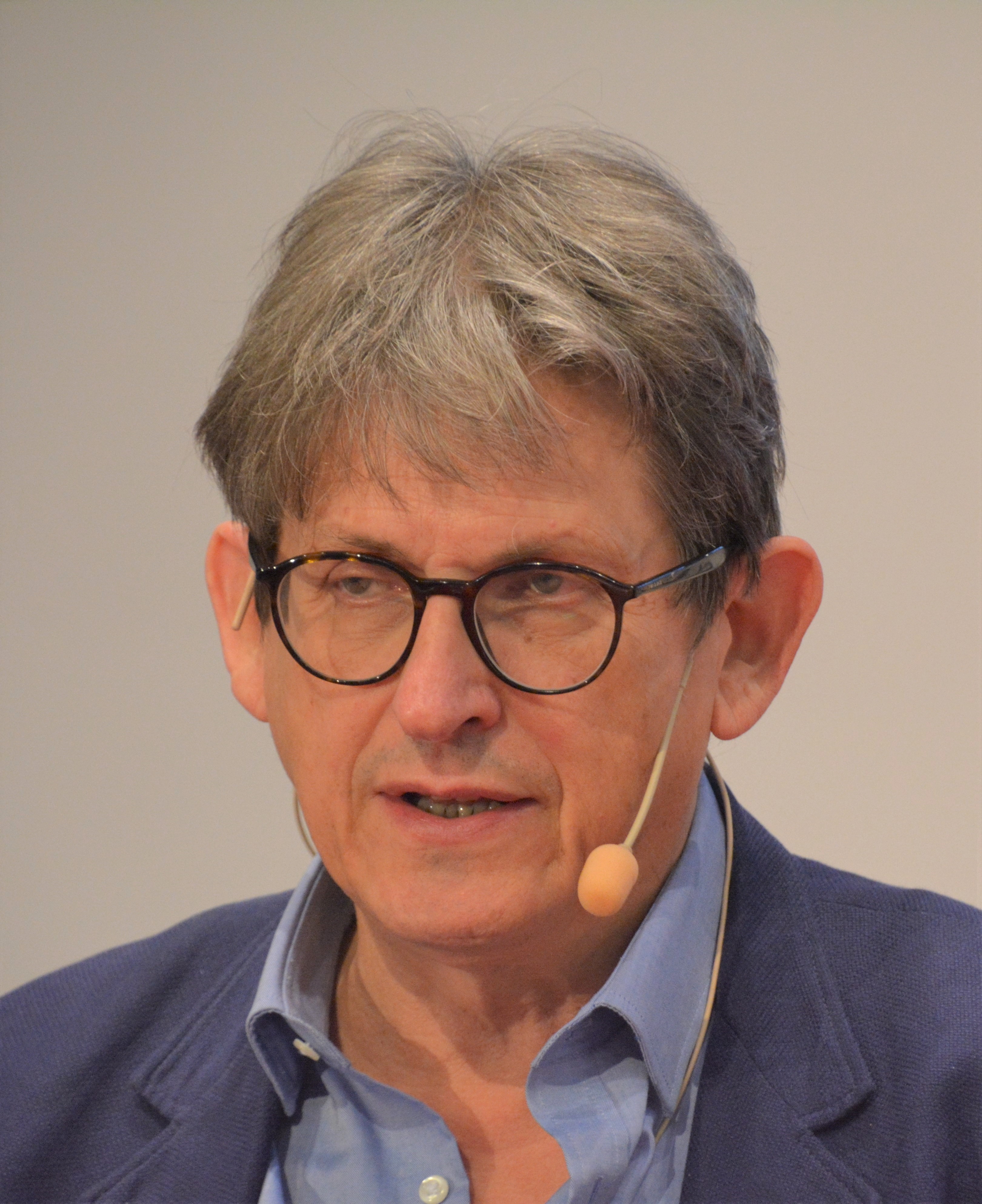
Alan Rusbridger citáty

Alan Rusbridger je britský novinář.

✵ 29. prosinec 1953
Alan Rusbridger foto
Alan Rusbridger: 18 citátů0 lajků

Alan Rusbridger citáty a výroky

Alan Rusbridger: Citáty anglicky

“You can't possibly care about debt relief and the Simpsons. If you listen to Ligeti and James Macmillan then why would you want to know who won the United game last night or which Cabernet Sauvignon to drink with your meal tonight? Get back into your box.
Something else missing from the Times of 1968 was anything to do with the home or emotional life. There is nothing about marriage, divorce, children, schools, au pairs, depression, drinking, health, drugs, teenagers, affairs, fashion, sex, successful relationships, failing relationships, interior decor, cancer, infertility, faith, grandparents - or any of the other things that make up the texture of our non-working lives.”

Alan Rusbridger

Rusbridger (2000) &quot; Versions of seriousness http://www.theguardian.com/dumb/story/0,7369,391891,00.html&quot;, The Guardian. 4 November 2000: Cited in: Raymond Boyle (2006) Sports Journalism: Context and Issues. p. 11 <br class="br">According to Boyle 2006 Rusbridger argued that &quot;changes in the broadsheet press simply reflects wider cultural shift in taste and the breaking down of areas of supposedly high and low culture.&quot; <br class="br">2000s

“We will encourage reporters to be as specific as possible about the source of any anonymous quotation.”

Alan Rusbridger

Alan Rusbridger. &quot; No more ghostly voices http://www.theguardian.com/politics/2000/jul/15/labour.labour1997to99.&quot; The Guardian. 14 July 2000; As cited in Bob Franklin, ‎Martin Hamer, ‎Mark Hanna (2005) Key Concepts in Journalism Studies. p. 134. <br class="br">2000s

“In the days when we could take it for granted that journalism mattered, we could only share assumptions about what it was, how it was delivered and funded, but this is not the case any more.”

Alan Rusbridger

Attributed to Alan Rusbridger (2008) in: David Kang (2013) &quot; Essay: Do the cultural industries make money or art? http://forewords.tumblr.com/post/653245658&quot; forewords.tumblr.com. <br class="br">2000s

“The BBC is almost certainly the best news organisation in the world – the most serious, comprehensive, ethical, accurate, international, wide-ranging, fair and impartial.”

Alan Rusbridger

Zdroj: 2010s, Does journalism exist? (2010), p. 5. Partly cited in: Bob Franklin (2013) The future of journalism. p. 1968.

“Unnoticed by most of the world, Julian Assange was developing into a most interesting and unusual pioneer in using digital technologies to challenge corrupt and authoritarian states.”

Alan Rusbridger

Rusbridger (2011). As cited in: Benedetta Brevini, ‎Arne Hintz, ‎Patrick McCurdy (2013) Beyond WikiLeaks: Implications for the Future of Communications, Journalism and Society. p. 1994.
2010s

“It would be difficult to devise a process more inclined to throw up errors than the production of a newspaper.”

Alan Rusbridger

Rusbridger (2000) as cited in Jarman, Ruth, ‎McClune, Billy (2007) Developing scientific literacy. p. 35.
2000s

“It took one tweet on Monday evening as I left the office to light the virtual touchpaper. At five past nine I tapped: "Now Guardian prevented from reporting parliament for unreportable reasons. Did John Wilkes live in vain?"… By the time I got home, after stopping off for a meal with friends, the Twittersphere had gone into meltdown. Twitterers had sleuthed down Farrelly's question, published the relevant links and were now seriously on the case. By midday on Tuesday "Trafigura" was one of the most searched terms in Europe, helped along by re-tweets by Stephen Fry and his 830,000-odd followers.
… One or two legal experts uncovered the Parliamentary Papers Act 1840, wondering if that would help? Common #hashtags were quickly developed, making the material easily discoverable. By lunchtime – an hour before we were due in court – Trafigura threw in the towel. The textbook stuff – elaborate carrot, expensive stick – had been blown away by a newspaper together with the mass collaboration of total strangers on the web. Trafigura thought it was buying silence. A combination of old media – the Guardian – and new – Twitter – turned attempted obscurity into mass notoriety.”

Alan Rusbridger

Alan Rusbridger &quot; The Trafigura fiasco tears up the textbook http://www.theguardian.com/commentisfree/libertycentral/2009/oct/14/trafigura-fiasco-tears-up-textbook&quot; The Guardian, Wednesday 14 October 2009; As cited in Paul Bradshaw, ‎Liisa Rohumaa (2013) The Online Journalism Handbook: Skills to survive and thrive in the Digital Age. p. 176. <br class="br">2000s

“When I look back over some of the most high-profile things we’ve done recently at The Guardian I see an interesting pattern emerging – a form of collaborative journalism that I can best describe as a mutualised newspaper.”

Alan Rusbridger

Alan Rusbridger "I've seen the future and it's mutual." British Journalism Review, Vol 20 (3), 2009. p. 19-26; Partly cited in: Santo da Cunha, Rodrigo do Espírito, and Rodrigo Martins Aragão. "Clicar, arrastar, girar: o conceito de interatividade em revistas para iPad."
2000s

“The papers should promote minority views as well as mainstream argument and should encourage dissent.”

Alan Rusbridger

Alan Rusbridger (2008) on The Guardian priorities, cited in: Richard Lance Keeble, John Tulloch, Florian Zollmann (2010) Peace journalism, war and conflict resolution. p. 301.
2000s

“[There is a] widespread feeling that newspapers are failing in their duty of truly representing the complexity of some of the most important issues in society.”

Alan Rusbridger

Alan Rusbridger (2005) in: &quot; Press needs greater scrutiny, says Guardian editor http://www.guardian.co.uk/media/2005/mar/10/theguardian.pressandpublishing1&quot; on guardian.co.uk, March 10, 2005: cited in: Tony Harcup (2007) The Ethical Journalist. p. 14. <br class="br">2000s

“We're no longer a once-a-day text medium for a predominantly domestic audience. Increasingly - around the clock - we use a combination of media in telling stories, and in commentary, to millions of users around the globe.”

Alan Rusbridger

Alan Rusbridger. &quot; We&#x27;re all doomed to be surprised http://www.theguardian.com/media/2007/aug/20/mondaymediasection3&quot; The Guardian, Monday 20 August 2007; Partly cited in: Peter English. &quot;Caught by the Web: The Case of Guardian News &amp; Media&#x27;s Sports Desk.&quot; Journal of Sports Media 7.1 (2012): 133-148. <br class="br">2000s

“There are plenty who think that, as our libel laws are cleaned up, smart lawyers are switching horses to privacy.”

Alan Rusbridger

Rusbridger (2011), as cited in: John Steel (2013) Journalism and Free Speech. p. 92.
2010s

Podobní autoři

William Henry Bragg foto
William Henry Bragg4
britský vědec None
Audrey Hepburn foto
Audrey Hepburn13
britská herečka None
Margaret Thatcher foto
Margaret Thatcher35
britská státnice a předsedkyně vlády Spojeného království None
George Harrison foto
George Harrison45
britský hudebník, bývalý člen Beatles None
Jerome Klapka Jerome foto
Jerome Klapka Jerome30
anglický humorista None
Alfred Hitchcock foto
Alfred Hitchcock17
britský režisér None
Freddie Mercury foto
Freddie Mercury38
britský muzikant, zpěvák a skladatel None
Clive Staples Lewis foto
Clive Staples Lewis113
britský spisovatel irského původu None
George Orwell foto
George Orwell133
anglický spisovatel a novinář None
David Bowie foto
David Bowie13
britský zpěvák, herec, hudební skladatel None