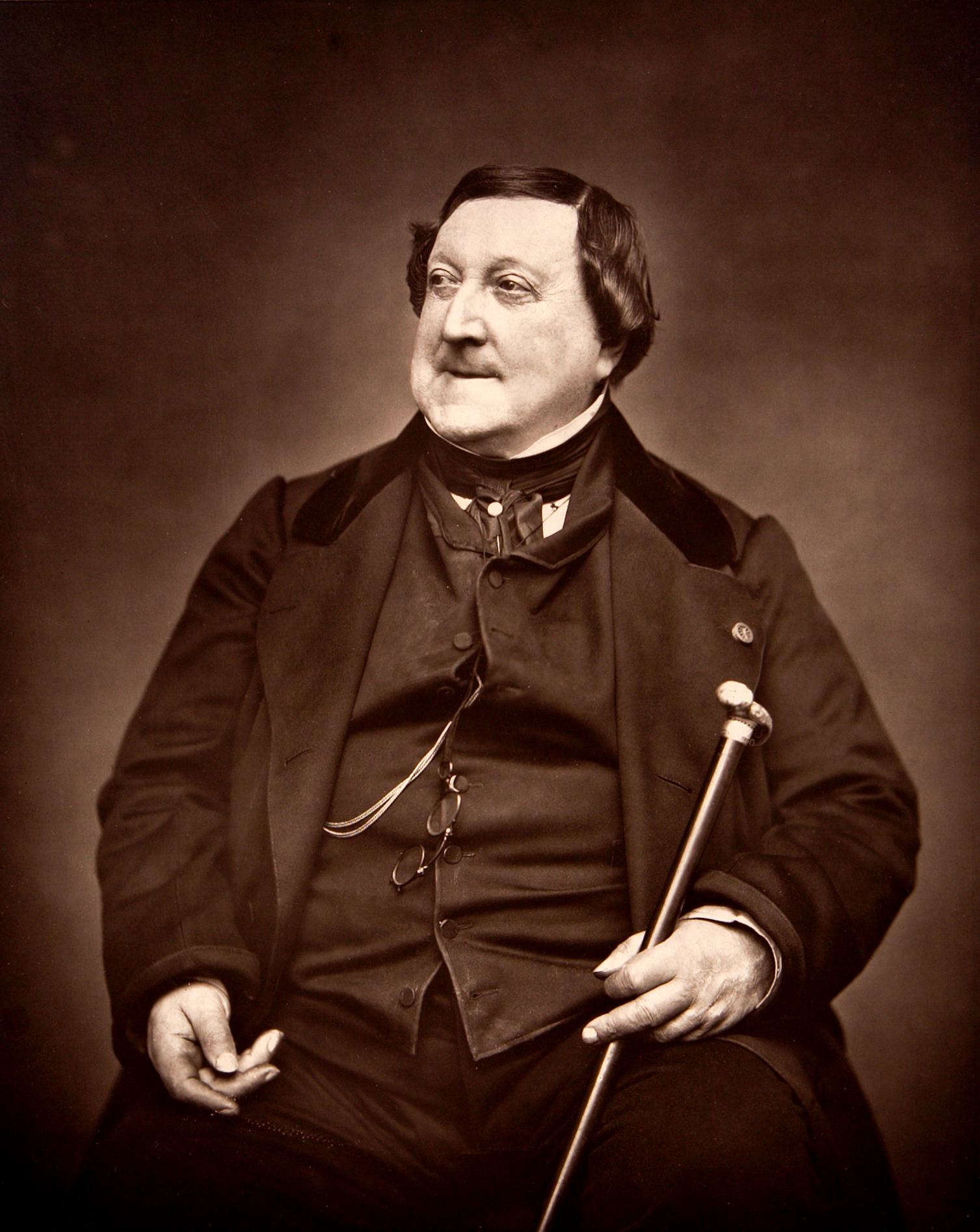
Gioacchino Rossini nejznámější citáty
„Jedení, milování, zpívání a trávení jsou čtyři akty komické opery známé jako život.“
Originál: (en) Eating, loving, singing and digesting are the four acts of the comic opera known as life.
Zdroj: [Matz, Matz, Johnson, Johnson, A night at the Opera: Stories of Great Operas with Early Intermediate to Intermediate Piano Arrangements, Alfred Music Publishing, 52]
Gioacchino Rossini: Citáty anglicky
“Simple melody and variety in rhythm.”
Melodia semplice e varietà nel ritmo.
His motto for Italian music, formulated in a letter to Filippo Filippi, August 26, 1868; Luca Somigli Legitimizing the Artist (2003) p. 103.
Often misquoted as "Simple melody – clear rhythm!"
“Give me the laundress' bill and I will set to music even that.”
Datemi il conto della lavandaia e vi metterò in musica anche quello.
Indro Montanelli L'Italia giacobina e carbonara, Rizzoli, Milano 1972, p. 612.
“Music is a kind of harmonious language.”
Zanolini, Biografia di Gioachino Rossini (1875)
“This little composition, which is, alas, the last mortal sin of my old age.”
Cette petite composition qui est, hélas, le dernier péché mortel de ma vieillesse.
Introductory note to the Petite Messe Solennelle. Translation from Justin Wintle (ed.) Makers of Nineteenth Century Culture (2002) vol. 2, p. 527.
“Monsieur Wagner has good moments, but awful quarters of an hour!”
Monsieur Wagner a de beaux moments, mais de mauvais quart d'heures.
Letter to Emile Naumann, April 1867, quoted in E Naumann Italienische Tondichter (1883) vol. 4, p. 5. Translation from The Riverside Dictionary of Biography (2005) p. 689.
Je le prends deux fois par semaine, Haydn quatre fois et Mozart tous les jours. Vous me direz, Beethoven est un colosse, qui vous donne souvent des coups de poing dans les côtes, tandisque Mozart est toujours adorable. C'est que lui a eu la chance d'aller très jeune en Italie à un époque, où l'on chantait encore bien.
Alfred Christlieb Kalischer Beethoven und seine Zeitgenossen (1908) p. 83. Translation from Charlotte Moscheles (trans. A. D. Coleridge) Life of Moscheles (1873) vol. 2, p. 275.
Bon Dieu; la voilà terminée, cette pauvre petite messe. Est-ce bien de la musique sacrée que je viens de faire, ou bien de la sacré musique ? J'étais né pour l'opera buffa, tu le sais bien! Peu de science, un peu de coeur, tout est là. Sois donc béni et accorde-moi le Paradis.
Epigraph to his Petite Messe Solennelle (1863). Translation from Emanuele Senici (ed.) The Cambridge Companion to Rossini (2004) p. 23.
Aspettate fino alla sera prima del giorno fissato per la rappresentazione. Nessuna cosa eccita più l'estro come la necessità, la presenza d'un copista, che aspetta il vostro lavoro e la ressa d'un impresario in angustie, che si strappa a ciocche i capelli. A tempo mio in Italia tutti gli impresari erano calvi a trent'anni.
From an undated letter, published in Luigi Rognoni Gioacchino Rossini (1968) p. 337. Translation from Josiah Fisk and Jeff Nichols (eds.) Composers on Music (1997) p. 67.
On the right time to write an overture.


