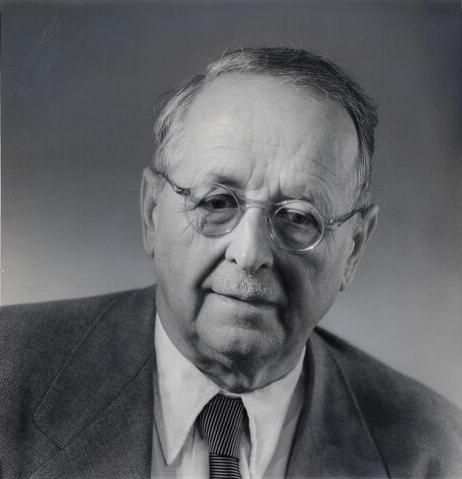
Hermann Weyl citáty

Hermann Klaus Hugo Weyl byl německý matematik, teoretický fyzik a filosof.

✵ 9. listopad 1885 – 8. prosinec 1955
Hermann Weyl foto
Hermann Weyl: 29 citátů6 lajků

Hermann Weyl citáty a výroky

„Bůh existuje, protože matematika je konzistentní, a ďábel existuje, protože to nemůžeme dokázat.“

Hermann Weyl

Originál: (de) Gott existiert, weil die Mathematik widerspruchsfrei ist, und der Teufel existiert, weil wir es nicht beweisen können.
Zdroj: [2000, Der"Gott" der Fakultäten: Gott der Wissenschaften, Gott, der Wissen schafft?: Philosophie, Psychologie, Rechtswissenschaft, Erziehungswissenschaft, Medizin, Mathematik, Informatik, Geowissenschaften, Wirtschaftswissenschaften, Politikwissenschaft, Kulturwissenschaften, LIT Verlag Münster, 151, Hamburger theologische Studien – Svazek 21, němčina]

Hermann Weyl: Citáty anglicky

“It was my wish to present this great subject as an illustration of the itermingling of philosophical, mathematical, and physical thought”

Hermann Weyl

From the Author's Preface to First Edition (1918)
Space—Time—Matter (1952)
Kontext: It was my wish to present this great subject as an illustration of the itermingling of philosophical, mathematical, and physical thought, a study which is dear to my heart. This could be done only by building up the theory systematically from the foundations, and by restricting attention throughout to the principles. But I have not been able to satisfy these self-imposed requirements: the mathematician predominates at the expense of the philosopher.

“It is in the composite idea of motion that these three fundamental conceptions enter into intimate relationship.”

Hermann Weyl

Introduction<!-- p. 1 -->
Space—Time—Matter (1952)
Kontext: Space and time are commonly regarded as the forms of existence of the real world, matter as its substance. A definite portion of matter occupies a definite part of space at a definite moment of time. It is in the composite idea of motion that these three fundamental conceptions enter into intimate relationship.

“Einstein's theory of relativity”

Hermann Weyl

From the Author's Preface to First Edition (1918)
Space—Time—Matter (1952)
Kontext: Einstein's theory of relativity has advanced our ideas of the structure of the cosmos a step further. It is as if a wall which separated us from Truth has collapsed. Wider expanses and greater depths are now exposed to the searching eye of knowledge, regions of which we had not even a presentiment. It has brought us much nearer to grasping the plan that underlies all physical happening.

“Only the consciousness that passes on in one portion of this world experiences the detached piece which comes to meet it and passes behind it as history, that is, as a process that is going forward in time and takes place in space.”

Hermann Weyl

Zdroj: Space—Time—Matter (1952), Ch. 3 "Relativity of Space and Time"<!-- p. 217 -->
Kontext: The scene of action of reality is not a three-dimensional Euclidean space but rather a four-dimensional world, in which space and time are linked together indissolubly. However deep the chasm may be that separates the intuitive nature of space from that of time in our experience, nothing of this qualitative difference enters into the objective world which physics endeavors to crystallize out of direct experience. It is a four-dimensional continuum, which is neither "time" nor "space". Only the consciousness that passes on in one portion of this world experiences the detached piece which comes to meet it and passes behind it as history, that is, as a process that is going forward in time and takes place in space.

“Time is the primitive form of the stream of consciousness.”

Hermann Weyl

Introduction<!-- p. 5 -->
Space—Time—Matter (1952)
Kontext: Time is the primitive form of the stream of consciousness.... If we project ourselves outside the stream of consciousness and represent its content as an object, it becomes an event happening in time, the separate stages of which stand to one another in the relations of earlier and later.

“Kant was the first to take the next decisive step”

Hermann Weyl

Introduction<!-- p. 3 -->
Space—Time—Matter (1952)
Kontext: In the field of philosophy Kant was the first to take the next decisive step towards the point of view that not only the qualities revealed by the senses, but also space and spatial characteristics have no objective significance in the absolute sense; in other words, that space, too, is only a form of our perception.

“Matter… could be measured as a quantity and… its characteristic expression as a substance was the Law of Conservation of Matter… This, which has hitherto represented our knowledge of space and matter, and which was in many quarters claimed by philosophers as a priori knowledge, absolutely general and necessary, stands to-day a tottering structure.”

Hermann Weyl

Introduction<!-- p. 1-2 -->
Space—Time—Matter (1952)
Kontext: The Greeks made Space the subject-matter of a science of supreme simplicity and certainty. and certainty Out of it grew, in the mind of classical antiquity, the idea of pure science. Geometry became one of the most powerful expressions of that sovereignty of the intellect that inspired the thought of those times. At a later epoch, when the intellectual despotism of the Church... had crumbled, and a wave of scepticism threatened to sweep away all that had seemed most fixed, those who believed in Truth clung to Geometry as to a rock, and it was the highest ideal of every scientist to carry on his science "more geometrico". Matter... could be measured as a quantity and... its characteristic expression as a substance was the Law of Conservation of Matter... This, which has hitherto represented our knowledge of space and matter, and which was in many quarters claimed by philosophers as a priori knowledge, absolutely general and necessary, stands to-day a tottering structure.

“It is the nature of a real thing to be inexhaustible in content; we can get an ever deeper insight into this content by the continual addition of new experiences, partly in apparent contradiction, by bringing them into harmony with one another.”

Hermann Weyl

Introduction<!-- p. 5 -->
Space—Time—Matter (1952)
Kontext: It is the nature of a real thing to be inexhaustible in content; we can get an ever deeper insight into this content by the continual addition of new experiences, partly in apparent contradiction, by bringing them into harmony with one another. In this interpretation, things of the real world are approximate ideas. From this arises the empirical character of all our knowledge of reality.

“We cannot hope to give here a final clarification of the essence of fact, judgement, object, property; this task leads into metaphysical abysses; about these one has to seek advice from men whose name cannot be stated without earning a compassionate smile—e. g. Fichte.”

Hermann Weyl

Das Kontinuum. Kritische Untersuchungen uber die Grundlagen der Analysis (1918), as quoted/translated by Erhard Scholz, &quot;Philosophy as a Cultural Resource and Medium of Reflection for Hermann Weyl&quot; http://arxiv.org/abs/math/0409596 (2004)

“Cartan developed a general scheme of infinitesimal geometry in which Klein's notions were applied to the tangent plane and not to the n-dimensional manifold M itself.”

Hermann Weyl

On the foundations of general infinitesimal geometry. Bull. Amer. Math. Soc. 35 (1929) 716–725 [10.1090/S0002-9904-1929-04812-2] (quote on p. 716)

“In these days the angel of topology and the devil of abstract algebra fight for the soul of each individual mathematical domain.”

Hermann Weyl Invariants

Weyl, Hermann. Invariants. Duke Math. J. 5 (1939), no. 3, 489--502. doi:10.1215/S0012-7094-39-00540-5. http://projecteuclid.org/euclid.dmj/1077491405.

“It seems clear that [set theory] violates against the essence of the continuum, which, by its very nature, cannot at all be battered into a single set of elements. Not the relationship of an element to a set, but of a part to a whole ought to be taken as a basis for the analysis of a continuum.”

Hermann Weyl

Riemanns geometrische Ideen, ihre Auswirkungen und ihre Verknüpfung mit der Gruppentheorie (1925), as quoted/translated by Erhard Scholz, "Philosophy as a Cultural Resource and Medium of Reflection for Hermann Weyl" (2004)

“Consciousness spreads out its web, in the form of time, over reality.”

Hermann Weyl

...spannt aber dadurch auch das Bewußtsein seine Form, die Zeit, über die Wirklichkeit aus...
Introduction
Space—Time—Matter (1952)

“This letter, if judged by the novelty and profundity of ideas it contains, is perhaps the most substantial piece of writing in the whole literature of mankind.”

Hermann Weyl

Symmetry (1952) (quote on p. 138; referring to a letter by Évariste Galois to Auguste Chevalier from May 29, 1832, two days before Galois&rsquo; death, containing a testamentary summary of Galois&rsquo; discoveries)

Podobní autoři

John Forbes Nash foto
John Forbes Nash4
americký matematik None
Robert Aumann foto
Robert Aumann1
izraelsko-americký matematik None
Curt Goetz foto
Curt Goetz16
německý herec None
Lion Feuchtwanger foto
Lion Feuchtwanger19
německý spisovatel None
Ernst Jünger foto
Ernst Jünger2
německý spisovatel, publicista None
Christian Morgenstern foto
Christian Morgenstern53
německý autor None
Martin Heidegger foto
Martin Heidegger11
německý filozof None
Bertrand Russell foto
Bertrand Russell49
logik a jeden z prvních analytických filozofů None
Erich Maria Remarque foto
Erich Maria Remarque144
německý spisovatel None
Erich von Manstein foto
Erich von Manstein10
německý generál None