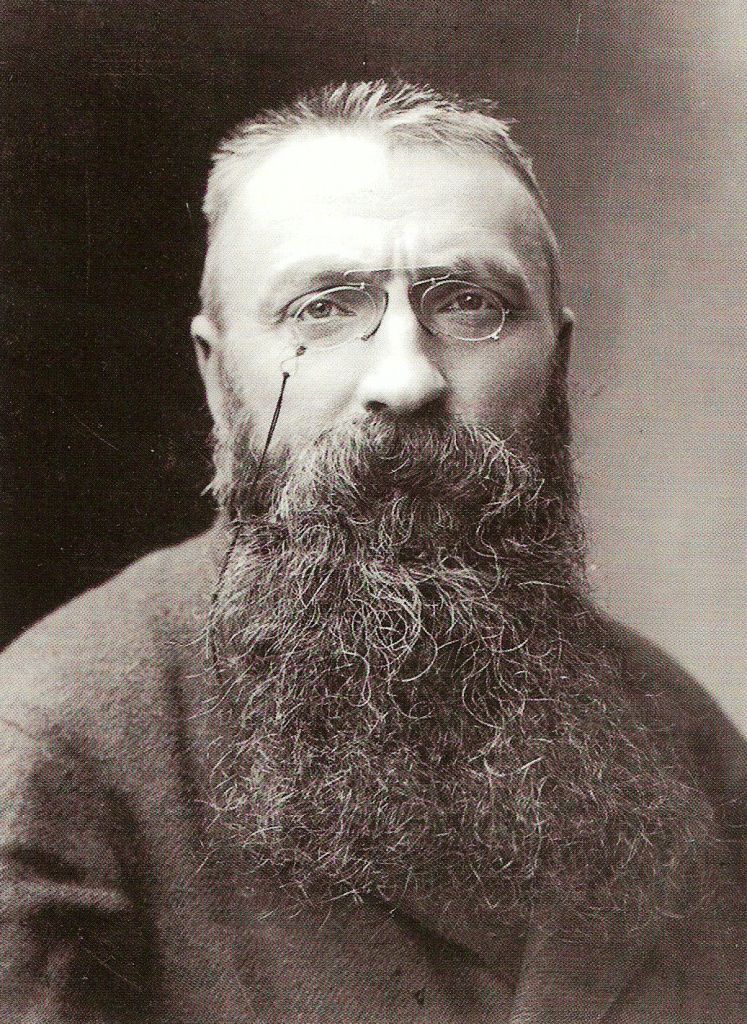

Auguste Rodin: 87 citátů702 lajků
Auguste Rodin nejznámější citáty
„Tělo je roztavenou hmotou, do níž se obtiskují vášně.“
Zdroj: [Pijoan, José, Dějiny umění 10, Knižní klub, 2000, 80-242-0218-2, 66, česky]
Auguste Rodin: Citáty o kráse
Auguste Rodin citáty a výroky
Zdroj: Moravská Hellas: http://life.ihned.cz/umeni-a-design/c1-51775400-moravska-hellas
Auguste Rodin: Citáty anglicky
Attributed to Rodin in H. Read (1964), as cited in: Karl H. Pfenninger, Valerie R. Shubik, Bruce Adolphe (2001). The Origins of Creativity. p. 50
1950s-1990s
“I invent nothing, I rediscover.”
Zdroj: Auguste Rodin: The Man, His Ideas, His Works, 1905, p. 60-61
Alternative translation:
I invent nothing, I rediscover. And the thing seems new because people have generally lost sight of the aim and the means of art ; they take that for an innovation which is nothing but a return to the laws of the great sculpture of long ago. Obviously, I think ; I like certain symbols, I see things in a synthetic way, but it is nature that gives me all that. I do not imitate the Greeks ; I try to put myself in the state of mind of the men who have left us the statues of antiquity. The schools copy their works, but what is of importance is to rediscover their methods. First I made close studies after nature, like "The Bronze Age." Later I understood that art required more breadth — exaggeration, in fact, and my aim was then, after the Burghers of Calais to find ways of exaggerating logically — that is to say, by reasonable amplification of the modeling. That, also consists in the constant reduction of the face to a geometrical figure, and the resolve to sacrifice every part of the face to the synthesis of its aspect. Look what they did in Gothic times. Take the Cathedral of Chartres as an example: one of its towers is massive and without ornamentation, having been neglected in order that the exquisite delicacy of the other could be better seen.
In: Andrew Carnduff Ritchie, John Rewald (1945). Aristide Maillol: With an Introduction and Survey of the Artist's Work in American Collections. p. 19
Kontext: I invent nothing, I rediscover. And the thing seems new because people have generally lost sight of the aim and the means of art; they take that for an innovation which is nothing but a return to the laws of the great sculpture of long ago. Obviously, I think; I like certain symbols, I see things in a synthetic way, but it is nature that gives me all that. I do not imitate the Greeks; I try to put myself in the spiritual State of the men who hâve left us the antique statues. The 'Ecole' copies their works; the thing that signifies is to recover their method. I began by showing close studies from nature like The Age of Brass. Afterwards I came to understand that art required a little more largeness, a little exaggeration, and my whole aim, from the time of the Burghers, was to find a method of exaggerating logically : that method consists in the deliberate amplification of the modelling. It consists also in the constant reduction of the figure to a geometrical figure, and in the determination to sacrifice any part of a figure to the synthesis of its aspect. See what the Gothic sculptors did. Look at the cathedra! of Chartres; one of the towers is massive and without ornament : they sacrificed it to give value to the exquisite delicacy of the other tower.
Zdroj: Auguste Rodin: The Man, His Ideas, His Works, 1905, p. 65
RODIN, AUGUSTE. L'Art. Entretiens réunis par Paul Gsell, 1911
Attributed to Rodin in: Southwestern Art Vol. 6 (1977). p. 20; Partly cited in: A Toolbox for Humanity: More Than 9000 Years of Thought (2004) by Lloyd Albert Johnson, p. 7
1950s-1990s
Kontext: The artist must learn the difference between the appearance of an object and the interpretation of this object through his medium. The artist must create a spark before he can make a fire and before art is born, the artist must be ready to be consumed by the fire of his own creation.
Zdroj: Art, 1912, Preface, p. 7-8
Kontext: Art is contemplation. It is the pleasure of the mind which searches into nature and which there divines the spirit by which Nature herself is animated. It is the joy of the intellect which sees clearly into the Universe and which recreates it, with conscientious vision. Art is the most sublime mission of man, since it is the expression of thought seeking to understand the world and to make it understood.
“In art, immorality cannot exist. Art is always sacred”
Albert Edward Elsen (1985). The Gates of Hell by Auguste Rodin. p. 131
1950s-1990s
Kontext: In art, immorality cannot exist. Art is always sacred even when it takes for a subject the worst excesses of desire; since it has in view only the sincerity of observation, it cannot debase itself. A true work of art is always noble, even when it translates the stirrings of the brute, for at that moment, the artist who has produced it had as his only objective, the most conscientious rendering possible of the impression he has felt.
Zdroj: Auguste Rodin: The Man, His Ideas, His Works, 1905, p. 2-3
Rodin on realism, 1910
Attributed to Auguste Rodin by Isadora Duncan, As quoted in Modern Dancing and Dancers (1912) by John Ernest Crawford Flitch, p. 105.
1900s-1940s
“I know very well that one must fight, for one is often in contradiction to the spirit of the age.”
As quoted in "Rodin freed human spirit" in The Des Moines Register (7 January 2007) http://www.dmregister.com/apps/pbcs.dll/article?AID=/20070107/ENT01/701070305 <br class="br">21st century
“I am not a rhetorician, but a man of action.”
Zdroj: Rodin : the man and his art, with leaves from his notebook, 1917, p. 105
In; Victor Frisch, Joseph Twadell Shipley (1939). Auguste Rodin. p. 203: About the act of creation.
1900s-1940s
Zdroj: Art, 1912, Ch. III. Modelling, p. 61
Zdroj: Art, 1912, Ch. I. Realism in Art, p. 29-30
Zdroj: Auguste Rodin: The Man, His Ideas, His Works, 1905, p. 2 About Barye's drawing classes at the Jardin des Plantes.
Zdroj: Art, 1912, Ch. V. Drawing and Color, p. 95-96
Auguste Rodin in: The Cornhill Magazine, (1925), p. 766; Cited in: Anthony Mario Ludovici (1926). Personal Reminiscences of Auguste Rodin. p. 111
1900s-1940s
Zdroj: Art, 1912, Ch. II. To the artist, all in nature is beautiful, p. 46
Zdroj: Auguste Rodin: The Man, His Ideas, His Works, 1905, p. 65-67
Zdroj: Art, 1912, Ch. VII. Of Yesterday and of to-day, p. 121
Zdroj: Art, 1912, Ch. I. Realism in Art, p. 33
Zdroj: Art, 1912, Ch. II. To the artist, all in nature is beautiful, p. 48
RODIN, AUGUSTE. L'Art. Entretiens réunis par Paul Gsell, 1911
Zdroj: Art, 1912, Ch. V. Drawing and Color, p. 96
“Nothing is a waste of time if you use the experience wisely.”
As quoted in Heads and Tales (1936) by Malvina Hoffman, p. 47
1900s-1940s
Zdroj: Rodin : the man and his art, with leaves from his notebook, 1917, p. 183; Rodin talks about cathedrals
“An artist must possess consummate technique in order to make us forget it.”
RODIN, AUGUSTE. L'Art. Entretiens réunis par Paul Gsell, 1911
Zdroj: Rodin : the man and his art, with leaves from his notebook, 1917, p. 125


