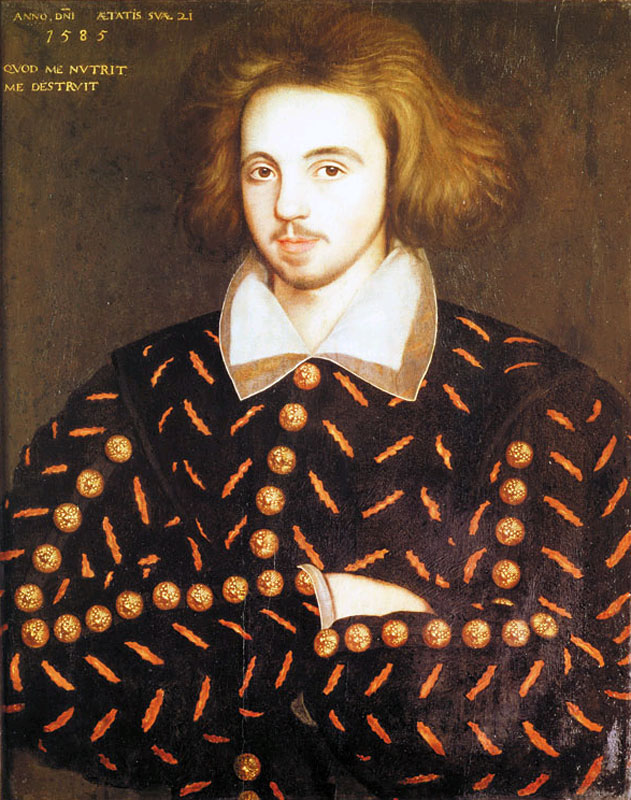
Christopher Marlowe citáty a výroky
Christopher Marlowe: Citáty anglicky
“Now will I show myself to have more of the serpent than the dove”
Christopher Marlowe The Jew of Malta
Barabas, Act II, scene iii. Marlowe is referencing Jesus, "Be ye therefore wise as serpents, and harmless as doves," in Matthew 10:16.
The Jew of Malta (c. 1589)
Kontext: Now will I show myself to have more of the serpent than the dove; that is, more knave than fool.
Christopher Marlowe kniha Hero and Leander
First Sestiad
Hero and Leander (published 1598)
“Pluck up your hearts, since fate still rests our friend.”
Aeneas, Act I, scene i, line 149
Dido (c. 1586)
“Thou hast committed—
Fornication: but that was in another country;
And besides, the wench is dead.”
Christopher Marlowe The Jew of Malta
Friar Barnardine and Barabas, Act IV, scene i
The Jew of Malta (c. 1589)
“Love me little, love me long.”
Christopher Marlowe The Jew of Malta
Ithamore, Act IV. Quoting John Heywood, "Love me litle, love me long," in Proverbes (c. 1538), Part ii, Chapter ii.
The Jew of Malta (c. 1589)
“Make me immortal with a kiss.”
Zdroj: Doctor Faustus and Other Plays, Parts 1-2
Christopher Marlowe The Jew of Malta
Barabas, Act I, scene i. Paraphrasing John Heywood, "Here lyeth muche rychnesse in lytell space," in The Foure PP https://books.google.com/books?id=LbkVAAAAYAAJ&printsec=frontcover&source#v=onepage&q&f=false (c. 1530). <br class="br">The Jew of Malta (c. 1589)
“Hell is just a frame of mind.”
Christopher Marlowe The Tragical History of Doctor Faustus
Zdroj: Dr. Faustus
“He that loves pleasure, must for pleasure fall.”
Christopher Marlowe The Tragical History of Doctor Faustus
Evil Angel, Act V, scene iv
Zdroj: Doctor Faustus (c. 1603)
Christopher Marlowe The Tragical History of Doctor Faustus
Zdroj: Dr. Faustus
“Fools that will laugh on earth, most weep in hell.”
Christopher Marlowe The Tragical History of Doctor Faustus
Zdroj: Doctor Faustus
“Who ever loved that loved not at first sight?”
Christopher Marlowe kniha Hero and Leander
First Sestiad. The same statement occurs in As You Like It (1600) by William Shakespeare, and a similar one in The Blind Beggar of Alexandria (1596) by George Chapman.
Hero and Leander (published 1598)
Varianta: Where both deliberate, the love is slight; Who ever loved, that loved not at first sight?
Christopher Marlowe The Tragical History of Doctor Faustus
Mephistopheles, Act II, scene i, line 118
Doctor Faustus (c. 1603)
Zdroj: Dr. Faustus
“Come live with me and be my Love,
And we will all the pleasures prove”
Zdroj: The Complete Plays and Poems
Faustus, Act V, scene i, lines 91–93
Doctor Faustus (c. 1603)
Zdroj: The Tragical History of Dr. Faustus
“What art thou Faustus, but a man condemned to die?”
Christopher Marlowe The Tragical History of Doctor Faustus
Zdroj: Dr. Faustus
“The stars move still, time runs, the clock will strike”
Christopher Marlowe The Tragical History of Doctor Faustus
Zdroj: Dr. Faustus
Christopher Marlowe The Tragical History of Doctor Faustus
Zdroj: Dr. Faustus
“What should a priest do with so fair a house?
A prison may best beseem his holiness.”
Gaveston, Act I, scene i, lines 204–205
Edward II (c. 1592)
Christopher Marlowe The Passionate Shepherd to His Love
The Passionate Shepherd to His Love (unknown date), stanzas 1 and 2. Compare: "To shallow rivers, to whose falls / Melodious birds sings madrigals; / There will we make our peds of roses, / And a thousand fragrant posies", William Shakespeare, Merry Wives of Windsor, act iii. scene i. (Sung by Evans.)


