Georg Cantor citáty

Georg Ferdinand Ludwig Philipp Cantor byl významný německý matematik a logik. Kromě matematiky se především v pozdějším věku intenzivně věnoval teologii, zejména ve vztahu k vlastní práci o nekonečnu. Je znám především tím, že teorii množin rozšířil o nekonečná čísla, označovaná jako ordinální čísla a kardinální čísla. Wikipedia  

✵ 19. únor 1845 – 6. leden 1918
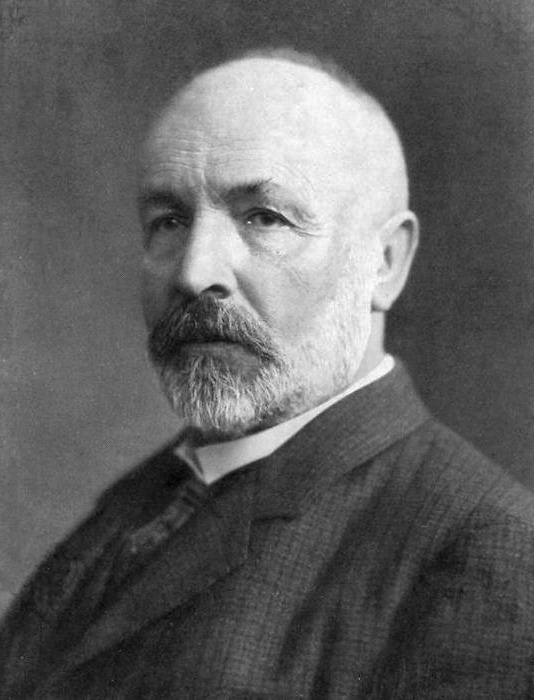
Georg Cantor foto
Georg Cantor: 28 citátů5 lajků

Georg Cantor citáty a výroky

„Podstata matematiky spočívá v její svobodě.“

Georg Cantor

Originál: (en) Das Wesen der Mathematik liegt in ihrer Freiheit.
Zdroj: [Menzier-Trott, Eckart, 2001, Gentzens Problem: Mathematische Logik im nationalsozialistischen Deutschland, Springer DE, 288, němčina]

Georg Cantor: Citáty anglicky

“I have never proceeded from any Genus supremum of the actual infinite. Quite the contrary, I have rigorously proved that there is absolutely no Genus supremum of the actual infinite. What surpasses all that is finite and transfinite is no Genus; it is the single, completely individual unity in which everything is included, which includes the Absolute, incomprehensible to the human understanding. This is the Actus Purissimus, which by many is called God.”

Georg Cantor

As quoted in Out of the Mouths of Mathematicians : A Quotation Book for Philomaths (1993) by Rosemary Schmalz.
Kontext: I have never proceeded from any Genus supremum of the actual infinite. Quite the contrary, I have rigorously proved that there is absolutely no Genus supremum of the actual infinite. What surpasses all that is finite and transfinite is no Genus; it is the single, completely individual unity in which everything is included, which includes the Absolute, incomprehensible to the human understanding. This is the Actus Purissimus, which by many is called God.
I am so in favor of the actual infinite that instead of admitting that Nature abhors it, as is commonly said, I hold that Nature makes frequent use of it everywhere, in order to show more effectively the perfections of its Author. Thus I believe that there is no part of matter which is not — I do not say divisible — but actually divisible; and consequently the least particle ought to be considered as a world full of an infinity of different creatures.
“Mathematics is in its development entirely free and is only bound in the self-evident respect that its concepts must both be consistent with each other, and also stand in exact relationships, ordered by definitions, to those concepts which have previously been introduced and are already at hand and established.”

Georg Cantor

From Kant to Hilbert (1996)
Kontext: Mathematics is in its development entirely free and is only bound in the self-evident respect that its concepts must both be consistent with each other, and also stand in exact relationships, ordered by definitions, to those concepts which have previously been introduced and are already at hand and established. In particular, in the introduction of new numbers, it is only obligated to give definitions of them which will bestow such a determinacy and, in certain circumstances, such a relationship to the other numbers that they can in any given instance be precisely distinguished. As soon as a number satisfies all these conditions, it can and must be regarded in mathematics as existent and real.

“I call this the improper infinite”

Georg Cantor

From Kant to Hilbert (1996)
Kontext: As for the mathematical infinite, to the extent that it has found a justified application in science and contributed to its usefulness, it seems to me that it has hitherto appeared principally in the role of a variable quantity, which either grows beyond all bounds or diminishes to any desired minuteness, but always remains finite. I call this the improper infinite [das Uneigentlich-unendliche].

“In mathematics the art of asking questions is more valuable than solving problems.”
In re mathematica ars proponendi quaestionem pluris facienda est quam solvendi.

Georg Cantor

Doctoral thesis (1867); variant translation: In mathematics the art of proposing a question must be held of higher value than solving it.

“This view [of the infinite], which I consider to be the sole correct one, is held by only a few.”

Georg Cantor

As quoted in Journey Through Genius (1990) by William Dunham ~
Kontext: This view [of the infinite], which I consider to be the sole correct one, is held by only a few. While possibly I am the very first in history to take this position so explicitly, with all of its logical consequences, I know for sure that I shall not be the last!

“My theory stands as firm as a rock; every arrow directed against it will return quickly to its archer.”

Georg Cantor

As quoted in Journey Through Genius (1990) by William Dunham
Kontext: My theory stands as firm as a rock; every arrow directed against it will return quickly to its archer. How do I know this? Because I have studied it from all sides for many years; because I have examined all objections which have ever been made against the infinite numbers; and above all because I have followed its roots, so to speak, to the first infallible cause of all created things.

“The transfinite numbers are in a certain sense themselves new irrationalities”

Georg Cantor

As quoted in Understanding the Infinite (1994) by Shaughan Lavine
Kontext: The transfinite numbers are in a certain sense themselves new irrationalities and in fact in my opinion the best method of defining the finite irrational numbers is wholly dissimilar to, and I might even say in principle the same as, my method described above of introducing transfinite numbers. One can say unconditionally: the transfinite numbers stand or fall with the finite irrational numbers; they are like each other in their innermost being; for the former like the latter are definite delimited forms or modifications of the actual infinite.

“The totality of all alephs cannot be conceived as a determinate, well-defined, and also a finished set.”

Georg Cantor

Letter to David Hilbert (2 October 1897)
Kontext: The totality of all alephs cannot be conceived as a determinate, well-defined, and also a finished set. This is the punctum saliens, and I venture to say that this completely certain theorem, provable rigorously from the definition of the totality of all alephs, is the most important and noblest theorem of set theory. One must only understand the expression "finished" correctly. I say of a set that it can be thought of as finished (and call such a set, if it contains infinitely many elements, "transfinite" or "suprafinite") if it is possible without contradiction (as can be done with finite sets) to think of all its elements as existing together, and to think of the set itself as a compounded thing for itself; or (in other words) if it is possible to imagine the set as actually existing with the totality of its elements.

“The essence of mathematics lies entirely in its freedom.”

Georg Cantor

Variant translation: The essence of mathematics is in its freedom.
From Kant to Hilbert (1996)

“Had Mittag-Leffler had his way, I should have to wait until the year 1984, which to me seemed too great a demand!”

Georg Cantor

Letter (1885), written after Gösta Mittag-Leffler persuaded him to withdraw a submission to Mittag-Leffler's journal Acta Mathematica, telling him it was "about one hundred years too soon."

“A set is a Many that allows itself to be thought of as a One.”

Georg Cantor

As quoted in Infinity and the Mind (1995) by Rudy Rucker. ~ ISBN 0691001723

“However, he was born in Copenhagen, of Jewish parents, of the Portuguese Jewish community there.”

Georg Cantor

Of his father. In a letter written by Georg Cantor to Paul Tannery in 1896 (Paul Tannery, Memoires Scientifique 13 Correspondance, Gauthier-Villars, Paris, 1934, p. 306)

“Every transfinite consistent multiplicity, that is, every transfinite set, must have a definite aleph as its cardinal number.”

Georg Cantor

Letter to Richard Dedekind (1899), as translated in From Frege to Gödel : A Source Book in Mathematical Logic, 1879-1931 (1967) by Jean Van Heijenoort, p. 117

“There is no doubt that we cannot do without variable quantities in the sense of the potential infinite. But from this very fact the necessity of the actual infinite can be demonstrated.”

Georg Cantor

"Über die verschiedenen Ansichten in Bezug auf die actualunendlichen Zahlen" ["Over the different views with regard to the actual infinite numbers"] - Bihand Till Koniglen Svenska Vetenskaps Akademiens Handigar (1886)

Podobní autoři

Lewis Carroll foto
Lewis Carroll19
anglický spisovatel, matematik, logik, anglikánský jáhen a … None
Auguste Comte foto
Auguste Comte11
francouzský filozof None
Thomas Hardy foto
Thomas Hardy19
anglický autor románů a básník None
Charles Darwin foto
Charles Darwin25
britský přírodovědec None
Joseph Conrad foto
Joseph Conrad7
polský autor None
Friedrich Von Bodenstedt foto
Friedrich Von Bodenstedt6
německý autor None
Henry David Thoreau foto
Henry David Thoreau146
americký autor a přírodovědec None
Léon Bloy foto
Léon Bloy13
None
Edmondo De Amicis foto
Edmondo De Amicis10
italský spisovatel None
Charles Spurgeon foto
Charles Spurgeon142
britský kazatel, autor a pastor None