„Hudba je jiný způsob myšlení. Potřebujeme občas přepnout, myslet jinak, nebo se zasekneme.“
Zdroj: [Platzová, Magdaléna, Hlavně se nezaseknout, Respekt, 2010, 24, 73]
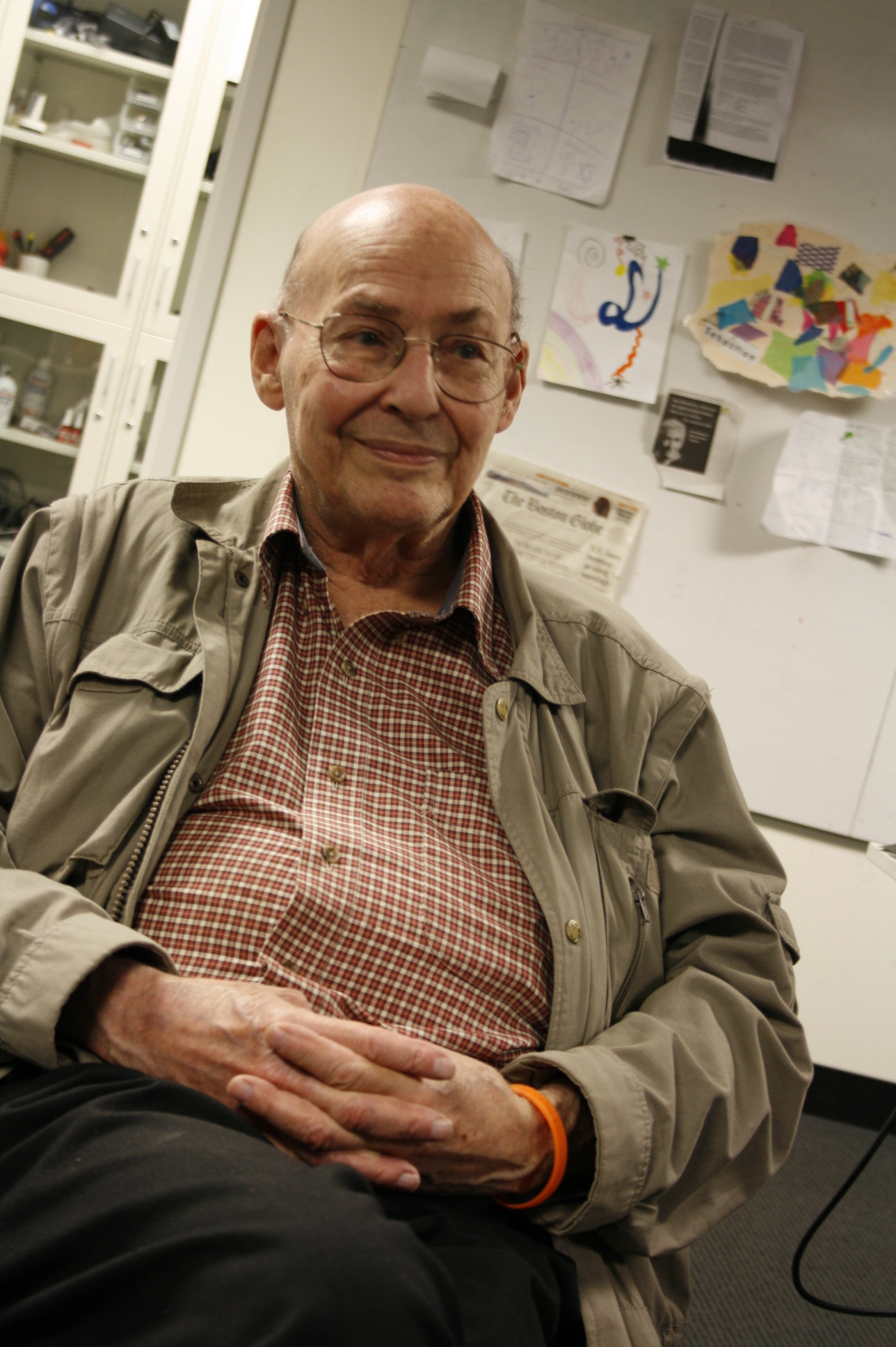
Marvin Lee Minsky byl americký vědec zabývající se umělou inteligencí. Byl spoluzakladatelem laboratoře umělé inteligence na MIT a autorem několika filosofických textů. Roku 1969 obdržel Turingovu cenu, nejprestižnější ocenění v oblasti informatiky. Wikipedia
„Hudba je jiný způsob myšlení. Potřebujeme občas přepnout, myslet jinak, nebo se zasekneme.“
Zdroj: [Platzová, Magdaléna, Hlavně se nezaseknout, Respekt, 2010, 24, 73]
“Every smart person wants to be corrected, not admired.”
Marvin Minsky kniha Society of Mind
In "The Society of Mind" MIT course, part 6, "Layers of Mental Activities" https://www.youtube.com/watch?v=qJZ_1a-t_sA (25:40 -- 26:15). Fall 2011. <br class="br">Kontext: If you like somebody's work -- just go and see them. However, don't ask for their autograph. A lot of people came and asked me for my autograph -- and it's creepy. What I did is read everything they published first... and correct them. That's what they really want. Every smart person wants to be corrected, not admired.
Marvin Minsky kniha Society of Mind
Zdroj: The Society of Mind (1987), Ch.2
Kontext: The "laws of thought" depend not only on the property of brain cells, but also on how they are connected. And these connections are established not by the basic, "general" laws of physics... To be sure, "general" laws apply to everything. But, for that very reason, they can rarely explain anything in particular.... Each higher level of description must add to our knowledge about lower levels.
Jokes and their Relation to the Cognitive Unconscious (1980)
Kontext: All intelligent persons also possess some larger-scale frame-systems whose members seemed at first impossibly different — like water with electricity, or poetry with music. Yet many such analogies — along with the knowledge of how to apply them — are among our most powerful tools of thought. They explain our ability sometimes to see one thing — or idea — as though it were another, and thus to apply knowledge and experience gathered in one domain to solve problems in another. It is thus that we transfer knowledge via the paradigms of Science. We learn to see gases and fluids as particles, particles as waves, and waves as envelopes of growing spheres.
K-Linesː A Theory of Memory (1980)
Kontext: When you "get an idea," or "solve a problem," or have a "memorable experience," you create what we shall call a K-line. This K-line gets connected to those "mental agencies" that were actively involved in the memorable event. When that K-line is later "activated," it reactivates some of those mental agencies, creating a "partial mental state" resembling the original.
Marvin Minsky kniha Society of Mind
Zdroj: The Society of Mind (1987), Ch.2
Kontext: Questions about arts, traits, and styles of life are actually quite technical. They ask us to explain what happens among the agents of our minds. But this is a subject about which we have never learned very much... Such questions will be answered in time. But it will just prolong the wait if we keep using pseudo-explanation words like "holistic" and "gestalt." …It's harmful, when naming leads the mind to think that names alone bring meaning close.
Music, Mind, and Meaning (1981)
Kontext: What is the difference between merely knowing (or remembering, or memorizing) and understanding?... A thing or idea seems meaningful only when we have several different ways to represent it — different perspectives and different associations.... Then we can turn it around in our minds, so to speak: however it seems at the moment, we can see it another way and we never come to a full stop. In other words, we can 'think' about it. If there were only one way to represent this thing or idea, we would not call this representation thinking.
“You don't understand anything until you learn it more than one way.”
In Managing an Information Security and Privacy Awareness and Training Program (2005) by Rebecca Herold, p. 101
In "The Many Minds of Marvin Minsky (R.I.P.)" by John Horgan, Scientific American Blogs, 26 January 2016 http://blogs.scientificamerican.com/cross-check/the-many-minds-of-marvin-minsky-r-i-p/
“An ethicist is someone who sees something wrong with whatever you have in mind.”
TED talk (February 2003) http://blog.ted.com/2008/09/health_populati.php
Marvin Minsky kniha Society of Mind
Zdroj: The Society of Mind (1987), Ch.1
“I maintain that attitudes do really precede propositions, feelings come before facts.”
K-Linesː A Theory of Memory (1980)
...What makes us such innate Copernicans?
Music, Mind, and Meaning (1981)
Marvin Minsky kniha Society of Mind
Prologue
The Society of Mind (1987)
Marvin Minsky kniha The Emotion Machine
The Emotion Machine (2006)
Jokes and their Relation to the Cognitive Unconscious (1980)
“When no idea seems right, the right one must seem wrong.”
Music, Mind, and Meaning (1981)
Jokes and their Relation to the Cognitive Unconscious (1980)
Jokes and their Relation to the Cognitive Unconscious (1980)
Mat Buckland, AI Techniques for Game Programming (2002), Cincinnati, OH: Premier Press, 36 ISBN 1-931841-08-X.
Attributed
Marvin Minsky kniha Society of Mind
Zdroj: The Society of Mind (1987), p. 308
Jokes and their Relation to the Cognitive Unconscious (1980)
Kontext: I am inclined to doubt that anything very resembling formal logic could be a good model for human reasoning. In particular, I doubt that any logic that prohibits self-reference can be adequate for psychology: no mind can have enough power — without the power to think about Thinking itself. Without Self-Reference it would seem immeasurably harder to achieve Self-Consciousness — which, so far as I can see, requires at least some capacity to reflect on what it does. If Russell shattered our hopes for making a completely reliable version of commonsense reasoning, still we can try to find the islands of "local consistency," in which naive reasoning remains correct.
“Will robots inherit the earth? Yes, but they will be our children.”
Scientific American (October 1994) http://web.media.mit.edu/~minsky/papers/sciam.inherit.html


