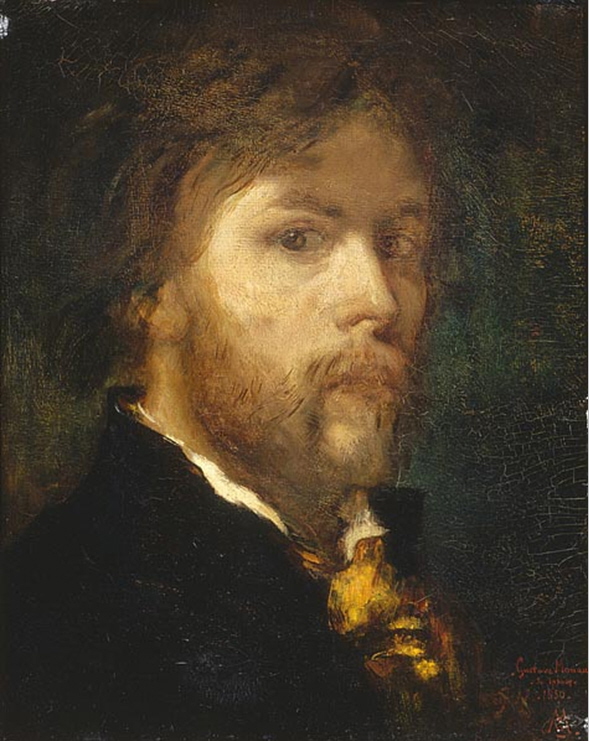
Gustave Moreau citáty

Gustave Moreau byl francouzský malíř, který používal především mytologické a biblické náměty.

✵ 6. duben 1826 – 18. duben 1898
Gustave Moreau foto
Gustave Moreau: 7 citátů3 lajky

Gustave Moreau citáty a výroky

Gustave Moreau: Citáty anglicky

“I am dominated by one thing, an irresistible, burning attraction towards the abstract.”

Gustave Moreau

Zdroj: Gustave Moreau (1972) by Jean Paladilhe and Josbe Pierre - transl. Bettina Wadia; Praeger, New York, 1972, p. 32
Kontext: I am dominated by one thing, an irresistible, burning attraction towards the abstract. The expression of human feelings and the passions of man certainly interest me deeply, but I am less concerned with expressing the motions of the soul and mind than to render visible, so to speak, the inner flashes of intuition which have something divine in their apparent insignificance and reveal magic, even divine horizons, when they are transposed into the marvellous effects of pure plastic art.

“I believe neither in what I touch nor what I see. I only believe in what I do not see, and solely in what I feel.”

Gustave Moreau

As quoted at the J. Paul Getty Museum http://www.getty.edu/art/gettyguide/artMakerDetails?maker=333&page=1

“I have designed a decorative and monumental work as a group of subjects representing the three ages of sacred and profane mythology: the Golden Age, the Silver Age and the Iron Age. I have symbolised these different ages by dividing each one into compositions representing the three phases of the day: morning, noon and evening.
The Golden Age comprises three compositions (Adam and childhood):
:1. Prayer at sunrise.
:2. A walk in Paradise or the ecstasy before nature.
:3. All nature asleep.
The Silver Age. The second phase is taken from pagan mythology (Orpheus and youth):
:1. The dream nature is revealed to the senses of the inspired poet.
:2. The song.
: 3. Orpheus in the forest, his lyre broken and he longs for unknown countries and immortality.
The Iron Age (Cain and the maturity of man):
:1. The Sower making the earth productive (production).
:2. The Ploughman (work).
:3. Death (Cain and Abel).
Fourth panel:
The Triumph of Christ.
These three periods of humanity also correspond to the three periods in the life of a man:
The purity of childhood: Adam –
The poetic and unhappy aspirations of youth: Orpheus –
The grievous sufferings and death of mature age: Cain with the redemption of Christ.
D— thought it was an extremely ingenious and intelligent device to have used a figure from pagan antiquity for the cycle of youth and poetry instead of a Biblical figure, because intelligence and poetry are far better personified in these periods which were devoted to art and the imagination than in the Bible which is all sentiment and religiosity.
The Golden Age: the beginning of the world, naïveté, candour, purity. The morning: prayer. Noon: ecstasy and evening: sleep. No passion, nothing but elementary feelings. —
The Silver Age, corresponding to the civilization of humanity, already begins to feel emotion; it is the age of poets. I can only find this cycle in Greece. The morning: inspiration. Noon: song. Evening: tears. —
The Iron Age. Decadence and fall of humanity. I shall represent Cain ploughing and Abel sowing. Noon: Cain rests while Abel tends the altar of the Lord from which smoke, a symbol of purity, rises straight to the heavens. The evening: death at the hands of Cain.
The first death corresponds to the other deaths in the two other paintings: sleep and death of the senses; tears and the death of the heart. Do you understand the progression?
Sleep, though sad, is gentler than tears which, though painful, are gentler than death. Ecstasy is more delightful than song, which is gentler than work. Prayer is superior to dreaming which is more elevated than manual work.”

Gustave Moreau

Notes to his mother, on The Life of Humanity (1884-6) http://www.wikiart.org/en/gustave-moreau/humanity-the-golden-age-depicting-three-scenes-from-the-lives-of-adam-and-eve-the-silver-age-1886, his composition of a ten image polyptych, p. 48 ·  Photo of its exhibition on the 3rd Floor of Musée National Gustave Moreau http://en.musee-moreau.fr/house-museum/studios/third-floor <br class="br">Gustave Moreau (1972)

“I have never looked for dream in reality or reality in dream. I have allowed my imagination free play, and I have not been led astray by it.”

Gustave Moreau

As quoted in &quot;The Many Faces of Gustave Moreau&quot; by Bennett Schiff in Smithsonian magazine (August 1999) http://www.smithsonianmagazine.com/issues/1999/august/moreau.php

Podobní autoři

Paul Cézanne foto
Paul Cézanne12
francouzský malíř None
Claude Monet foto
Claude Monet10
francouzský impresionalistický malíř None
Eugéne Delacroix foto
Eugéne Delacroix20
francouzský romantický malíř None
Paul Gauguin foto
Paul Gauguin12
francouzský post-impresionistický umělec None
Émile Zola foto
Émile Zola28
francouzský spisovatel, představitel naturalismu None
Gustave Flaubert foto
Gustave Flaubert43
francouzský spisovatel None
Vincent Van Gogh foto
Vincent Van Gogh41
holandský malíř None
Alfred De Musset foto
Alfred De Musset18
francouzský spisovatel None
Jules Renard foto
Jules Renard26
francouzský spisovatel None
Charles Baudelaire foto
Charles Baudelaire41
francouzský básník None