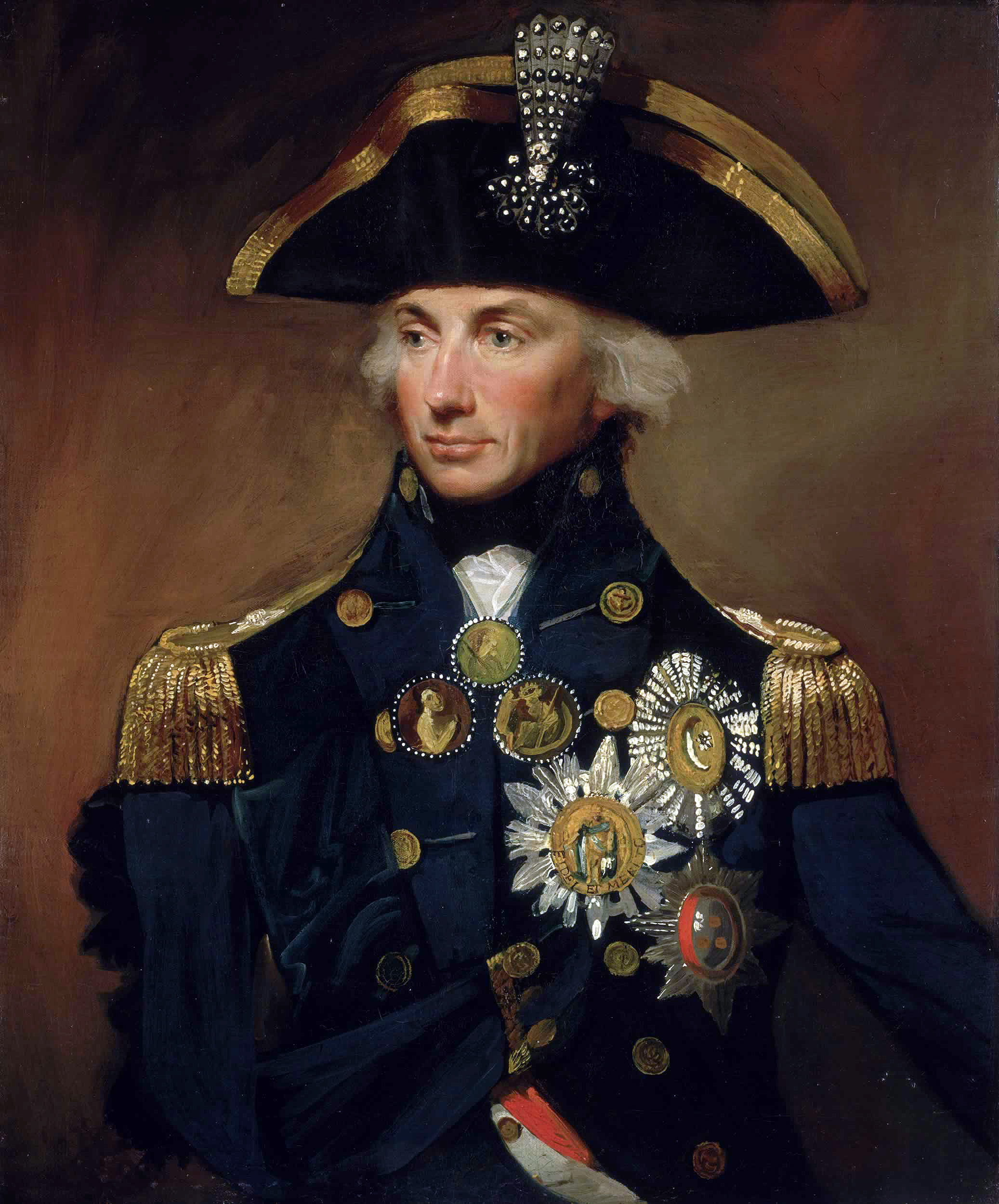
Horatio Nelson nejznámější citáty
Zdroj: [Novotný, František, Plachty v ohni. Od Vikingů k Sinopu, Albratros, Praha, 2009, 414, 978-80-00-01873-7]
„Anglie očekává, že každý muž splní svou povinnost.“
[(en) England expects that every man will do his duty.].
Zdroj: [James, William, Chamier, Frederick, The naval history of Great Britain: from the declaration of war by France in 1793 to the accession of George IV, R. Bentley, 1837, 34, anglicky]
Horatio Nelson: Citáty anglicky
“Thank God, I have done my duty.”
Statement among his final dying words. [citation needed]
The Battle of Trafalgar (1805)
“First gain the victory and then make the best use of it you can.”
Before the battle of the Nile (1 August 1797) [citation needed]
1790s
Statement (August 1801) [citation needed]
1800s
“Time is everything; five minutes make the difference between victory and defeat.”
Frothingham, Jessie Peabody. Sea Fighters from Drake to Farragut New York: Charles Scribner's Sons, 1902. p. 314
1800s
“Desperate affairs require desperate measures.”
As quoted in The Book of Military Quotations (1992) edited by Peter G. Tsouras, p. 54
1800s
In response to the cheer that was raised after he sent the signal "England expects every Man will do his Duty.", as quoted in The Life of Admiral Lord Nelson, K.B. from His Lordship's Manuscripts (1810) by James Stanier Clarke and John McArthur, p. 667
The Battle of Trafalgar (1805)
“England expects every Man will do his Duty.”
Famous signal to the British fleet before the battle of Trafalgar, as quoted in Life of Nelson, Ch. 9; Initially dictated as: "England confides that every man shall do his duty." The signaller pointed out that "expects" was in the signals alphabet, but "confides" was not and so had to be spelt out, taking longer, and Nelson agreed to the change.
Variant:
England expects every officer and man to do his duty this day.
As reported in The London Times (26 December 1805)
The Battle of Trafalgar (1805)
“Wherever there is anything to be done, there Providence is sure to direct my steps.”
Letter to his wife, Frances Nelson (2 August 1796), as published in The Dispatches and Letters of Vice Admiral Lord Viscount Nelson with Notes (1845) edited Nicholas Harris Nicolas, Vol. II : 1795-1797, p. 203
1790s
Kontext: !-- Had all my actions, my dearest Fanny, been gazetted, not one fortnight would have passed during the whole war without a letter from me: one day or other I will have a long Gazette to myself; I feel that such an opportunity will be given me. --> I cannot, if I am in the field for glory, be kept out of sight. Probably my services may be forgotten by the great, by the time I get Home; but my mind will not forget, nor cease to feel, a degree of consolation and of applause superior to undeserved rewards. Wherever there is anything to be done, there Providence is sure to direct my steps. Credit must be given me in spite of envy. <!-- Even the French respect me: their Minister at Genoa, in answering a Note of mine, when returning some wearing apparel that had been taken, said, ‘Your Nation, Sir, and mine, are made to show examples of generosity, as well as of valour, to all the people of the earth.
At the battle of Copenhagen, Ignoring Admiral Parker's signal to retreat, holding his telescope up to his blind eye, and proceeding to victory against the Danish fleet. (2 April 1801); as quoted in Life of Nelson, Ch. 7
1800s
Kontext: To leave off action"? Well, damn me if I do! You know, Foley, I have only one eye,— I have a right to be blind sometimes... I really do not see the signal!
“I cannot, if I am in the field for glory, be kept out of sight.”
Letter to his wife, Frances Nelson (2 August 1796), as published in The Dispatches and Letters of Vice Admiral Lord Viscount Nelson with Notes (1845) edited Nicholas Harris Nicolas, Vol. II : 1795-1797, p. 203
1790s
Kontext: !-- Had all my actions, my dearest Fanny, been gazetted, not one fortnight would have passed during the whole war without a letter from me: one day or other I will have a long Gazette to myself; I feel that such an opportunity will be given me. --> I cannot, if I am in the field for glory, be kept out of sight. Probably my services may be forgotten by the great, by the time I get Home; but my mind will not forget, nor cease to feel, a degree of consolation and of applause superior to undeserved rewards. Wherever there is anything to be done, there Providence is sure to direct my steps. Credit must be given me in spite of envy. <!-- Even the French respect me: their Minister at Genoa, in answering a Note of mine, when returning some wearing apparel that had been taken, said, ‘Your Nation, Sir, and mine, are made to show examples of generosity, as well as of valour, to all the people of the earth.
Letter from Agamemnon at sea (10 March 1795), in Nelson's letters to his wife and other documents, 1785-1831 edited by Navy Records Society, p. 199
1790s
Kontext: The lives of all are in the hands of Him who knows best whether to preserve it or no, and to His will do I resign myself. My character and good name are in my own keeping. Life with disgrace is dreadful. A glorious death is to be envied, and, if anything happens to me recollect death is a debt we must all pay, and whether now or in a few years hence can be but of little consequence.
Captain Alfred Thayer Mahan, The Life of Nelson: The Embodiment of the Sea Power of Great Britain, Volume 2. New York: Cambridge University Press, 1897, p. 52; attributed by Mahan to Locker's Greenwich Gallery article "Torrington".
1800s
“I cannot command winds and weather.”
As quoted in Letters and Despatches of Horatio, Viscount Nelson, K.B. (1886) edited by John Knox Laughton, p. 99
1800s
From a letter to Admiral Cuthbert Collingwood, written while aboard HMS Victory and dated (14 March 1805), quoted in full in The Naval History of Great Britain from the year 1783 to 1822 by Captain Edward Pelham Brenton (1824), Vol III, p. 406
1800s
citation needed
The Battle of Trafalgar (1805)
“Before this time to-morrow I shall have gained a peerage, or Westminster Abbey.”
Before the Battle of the Nile (1 August 1797), as quoted in Life of Nelson, Ch. 5; alternately reported as "Westminster Abbey, or victory!"
1790s
“Something must be left to chance; nothing is sure in a sea fight above all.”
Before the battle of Trafalgar [citation needed]
The Battle of Trafalgar (1805)
“This is too warm work, Hardy, to last long.”
citation needed
The Battle of Trafalgar (1805)
On American ships sighted sometime between 1801 and 1803, as quoted in The Royal Navy: Its Influence in English History and in the Growth of Empire https://books.google.com/books?id=mlNnAAAAMAAJ&pg=PA149 (1914) by John Leyland <br class="br">1800s
“Victory or Westminster Abbey.”
Life of Nelson Vol. I, Ch. 4 : In the battle off Cape Vincent, giving order for boarding the San Josef
1800s
“In honour I gained them, and in honour I will die with them.”
Life of Nelson (ch. 9), when asked to cover the stars on his uniform to hide his rank during battle.
1800s
"Plan of Attack" (1805), drawn up during pursuit of the French fleet to the West Indies, as published in The Dispatches and Letters of Vice Admiral Lord Viscount Nelson with Notes (1866) edited by Sir Nicholas Harris Nicolas, Vol. VI : May 1804 - July 1805, p. 443
The Battle of Trafalgar (1805)
After being wounded during the attack on Santa Cruz de Tenerife (24 July 1797), as quoted in The Dispatches and Letters of Vice Admiral Lord Viscount Nelson with Notes (1845) edited Nicholas Harris Nicolas, Vol. II : 1795-1797, p. 423
1790s
letter from Sir Thomas Buxton to his son quoted in "Life of Sir Thomas Fowell Buxton" from Sylvanus Urban (ed.) The Gentleman's Magazine" July to December 1848, p. 577
1800s
At the Battle of Copenhagen (2 April 1801) [citation needed]
1800s
“I am Lord Nelson. See, here's my fin.”
Indicating his stub of his missing arm during the battle of Copenhagen, as quoted in Nelson and the Hamiltons (1969) by Jack Russell, p. 238
1800s
Statement regarding the attack on Bastia, Corsica (3 May 1794), as published in The Dispatches and Letters of Vice Admiral Lord Viscount Nelson with Notes (1845) edited by Sir Nicholas Harris Nicolas, Vol. I : 1777-1794, p. 393
1790s
On being welcomed on arrival in Great Yarmouth, in his home county [citation needed]
1790s
citation needed
The Battle of Trafalgar (1805)


