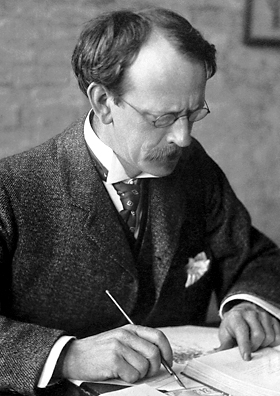
Joseph John Thomson citáty

Sir Joseph John Thomson byl anglický experimentální fyzik, který objevil elektron v roce 1897 při studiu elektrické vodivosti plynů, přesněji vlastností katodového záření. Za tento objev, kterým započala éra částicové fyziky, obdržel v roce 1906 Nobelovu cenu za fyziku.

Jako ředitel Cavendishovy laboratoře na Univerzitě v Cambridge vedl či podporoval celou řadu základních experimentů, které stály u zrodu moderní fyziky na počátku 20. století. Pod jeho vedením pracovala řada pozdějších držitelů Nobelových cen a v letech 1906–1907 také český fyzik František Záviška.

Thomsonův syn, George Paget Thomson, získal též Nobelovu cenu za fyziku v roce 1937.

Zajímavostí a také trochu ironií moderní fyziky je, že George Thomson, na rozdíl od svého otce, který prokázal existenci elektronu jako nové částice, obdržel Nobelovu cenu za výzkum vlnových vlastností elektronu při difrakci elektronů na krystalech . Wikipedia  

✵ 18. prosinec 1856 – 30. srpen 1940
Joseph John Thomson foto
Joseph John Thomson: 9 citátů0 lajků

Joseph John Thomson citáty a výroky

„Nejde přitom o objevení osamělého ostrova, ale celého kontinentu nového vědeckého myšlení. Je to nejvýznamnější objev gravitačního učení od doby, kdy Newton vyslovil své základní zákony.“

Joseph John Thomson

o teorii relativity
Zdroj: [Karamanolis, Stratis, Albert Einstein - teorie relativity pro každého, MAC, 1994, 80-901839-0-5, 78, česky]

Joseph John Thomson: Citáty anglicky

“The difficulties which would have to be overcome to make several of the preceding experiments conclusive are so great as to be almost insurmountable.”

J. J. Thomson

Warning about the non-conclusiveness for the experimental foundation of electrostatic theory, in a footnote of the third edition of: [James Clerk Maxwell, A Treatise on Electricity and Magnetism, Vol.1, 3rd Edition, Oxford University Press, 1891, 37]
Quotes eat me

“The electron: may it never be of any use to anybody!”

J. J. Thomson

A popular toast or slogan at J. J. Thomson's Cavendish Laboratory in the first years of the 1900s, as quoted in Proceedings of the Royal Institution of Great Britain, Volume 35 (1951), p. 251.
Attributed

“I can see no escape from the conclusion that they are charges of negative electricity carried by particles of matter.”

J. J. Thomson

&quot;Cathode rays&quot; http://web.lemoyne.edu/~GIUNTA/thomson1897.html Philosophical Magazine, 44, 293 (1897). <br class="br">Quotes eat me <br class="br">Kontext: As the cathode rays carry a charge of negative electricity, are deflected by an electrostatic force as if they were negatively electrified, and are acted on by a magnetic force in just the way in which this force would act on a negatively electrified body moving along the path of these rays, I can see no escape from the conclusion that they are charges of negative electricity carried by particles of matter.

“We see from Lenard's table that a cathode ray can travel through air at atmospheric pressure a distance of about half a centimetre before the brightness of the phosphorescence falls to about half its original value. Now the mean free path of the molecules of air at this pressure is about 10-5 cm., and if a molecule of air were projected it would lose half its momentum in a space comparable with the mean free path. Even if we suppose that it is not the same molecule that is carried, the effect of the obliquity of the collisions would reduce the momentum to half in a short multiple of that path. Thus, from Lenard's experiments on the absorption of the rays outside the tube, it follows on the hypothesis that the cathode rays are charged particles moving with high velocities, that the size of the carriers must be small compared with the dimensions of ordinary atoms or molecules. The assumption of a state of matter more finely subdivided than the atom of an element is a somewhat startling one; but a hypothesis that would involve somewhat similar consequences—viz. that the so-called elements are compounds of some primordial element—has been put forward from time to time by various chemists.”

J. J. Thomson

Royal Institution Lecture (April 30, 1897) as quoted by Edmund Taylor Whittaker, A History of the Theories of Aether and Electricity from the Age of Descartes to the Close of the Nineteenth Century http://books.google.com/books?id=CGJDAAAAIAAJ (1910). <br class="br">Quotes eat me

Podobní autoři

Stephen Hawking foto
Stephen Hawking44
britský teoretický fyzik zabývající se vznikem vesmíru None
Paul Dirac foto
Paul Dirac5
teoretický fyzik None
Jóičiró Nambu foto
Jóičiró Nambu1
americký fyzik None
Jerome Isaac Friedman foto
Jerome Isaac Friedman1
americký fyzik None
Wolfgang Pauli foto
Wolfgang Pauli7
rakouský fyzik None
Lev Davidovič Landau foto
Lev Davidovič Landau1
sovětský fyzik None
Richard Feynman foto
Richard Feynman25
americký kvantový fyzik None
William Henry Bragg foto
William Henry Bragg4
britský vědec None
Max Planck foto
Max Planck14
německý fyzik None
Karl Werner Heisenberg foto
Karl Werner Heisenberg7
německý teoretický fyzik None