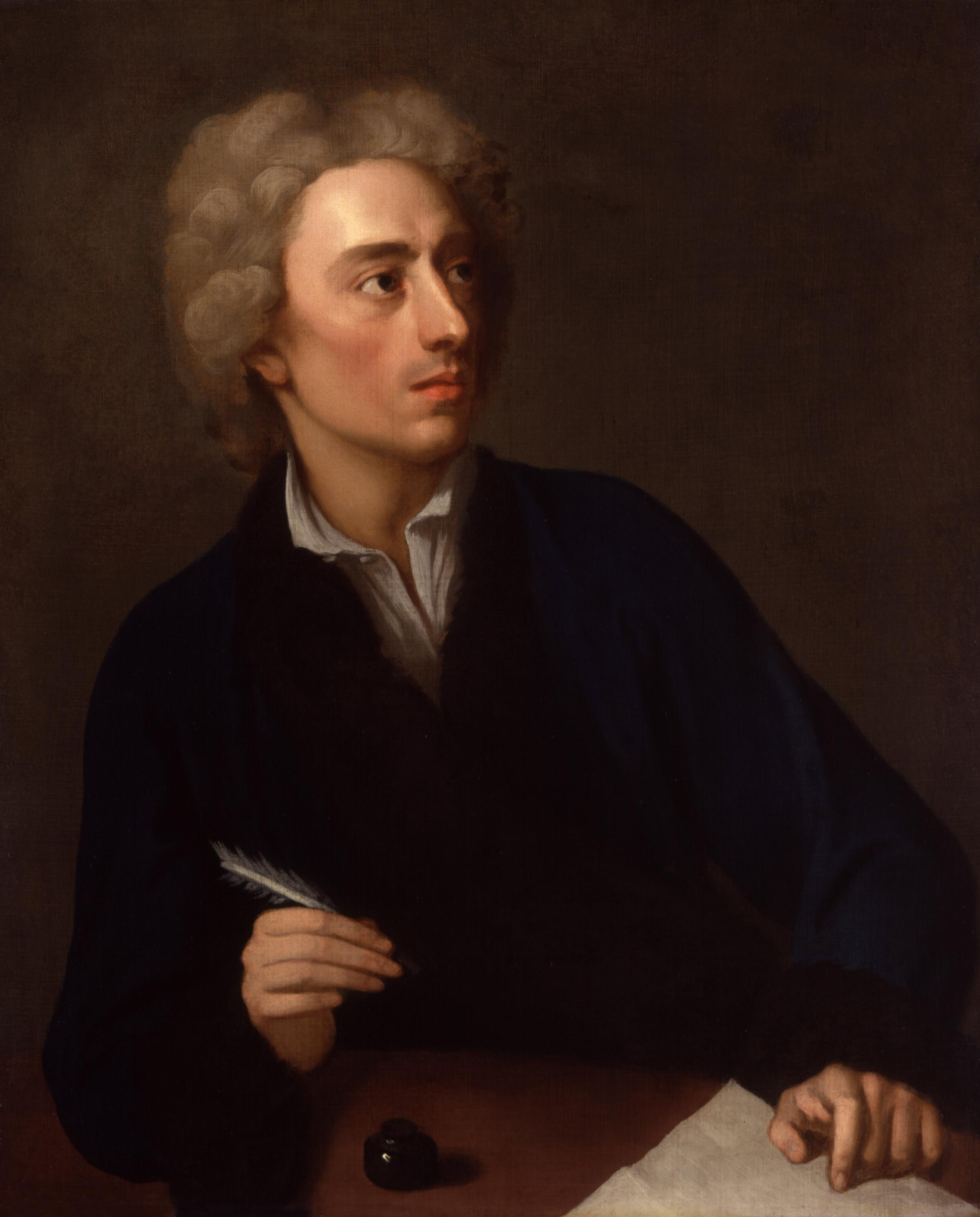
Alexander Pope nejznámější citáty
Alexander Pope: Citáty o lidech
„Historie je spíš plná příkladů věrnosti psů než lidí.“
Varianta: Historie je spíše plná příkladů věrnosti psů než přátel.
Alexander Pope citáty a výroky
„Člověk bývá tak sebevědomý, jak je omezeno jeho chápání.“
Varianta: Člověk bývá tak sebevědomí, jak je omezeno jeho chápání.
„Společnost je šílenství mnoha, aby jen pár z nás trpělo.“
Originál: (en) Party is the madness of many, for the gain of a few.
Zdroj: [Pope, Alexander, 1822, The works of Alexander Pope, Svazek 6, Printed for R. Priestley, 381, angličtina]
Alexander Pope: Citáty anglicky
“Our judgments, like our watches, none
go just alike, yet each believes his own”
Alexander Pope An Essay on Criticism
Zdroj: An Essay on Criticism
“True ease in writing comes from art, not chance,
As those move easiest who have learn'd to dance.”
Alexander Pope An Essay on Criticism
Zdroj: An Essay on Criticism (1711)
“Death, only death, can break the lasting chain;
And here, ev'n then, shall my cold dust remain”
Alexander Pope Eloisa to Abelard
Zdroj: Eloisa to Abelard
Zdroj: Prologue to Mr. Addison's Cato (1713), Line 1.
“Nature and Nature's laws lay hid in night:
God said, "Let Newton be!"”
and all was light.
Epitaph intended for Sir Isaac Newton.
Alexander Pope Moral Essays
The Universal Prayer (1738)
Zdroj: Moral Essays
“The world forgetting, by the world forgot.
Eternal sunshine of the spotless mind!”
Alexander Pope Eloisa to Abelard
Zdroj: Eloisa to Abelard
“Histories are more full of Examples of the Fidelity of dogs than of Friends.”
Letter to Henry Cromwell (19 October 1709).
Zdroj: Letters of the Late Alexander Pope, Esq. to a Lady. Never Before Published
“And die of nothing but a rage to live”
Alexander Pope Moral Essays
Varianta: You purchase pain with all that joy can give and die of nothing but a rage to live.
Zdroj: Moral Essays
“Men must be taught as if you taught them not,
And things unknown propos'd as things forgot.”
Alexander Pope An Essay on Criticism
Zdroj: An Essay on Criticism
Alexander Pope An Essay on Criticism
Zdroj: An Essay on Criticism
Zdroj: Epistles and Satires of Alexander Pope
Alexander Pope An Essay on Man
Zdroj: An Essay on Man
“What dire offence from amorous causes springs,
What mighty contests rise from trivial things!”
Alexander Pope The Rape of the Lock
Canto I, line 1.
Zdroj: The Rape of the Lock (1712, revised 1714 and 1717)
Letter, written in collaboration with Henry St John, 1st Viscount Bolingbroke, to Jonathan Swift, December 14, 1725.
Reported in The Poems of Alexander Pope, ed. John Butt, sixth edition (Yale University Press, 1970), p. 832: "Verbatim from Boileau", written c. 1740, published 1741.. Compare: "Tenez voilà", dit-elle, "à chacun une écaille, Des sottises d'autrui nous vivons au Palais; Messieurs, l'huître étoit bonne. Adieu. Vivez en paix", Nicholas Boileau-Despreaux, Epître II. (à M. l'Abbé des Roches).
“Let spades be trumps! she said, and trumps they were.”
Alexander Pope The Rape of the Lock
Canto III, line 46.
The Rape of the Lock (1712, revised 1714 and 1717)
Alexander Pope kniha Windsor Forest
Zdroj: Windsor Forest (1713), Line 13.
“To be angry, is to revenge the fault of others upon ourselves.”
Thoughts on Various Subjects (1727)
“Love seldom haunts the breast where learning lies,
And Venus sets ere Mercury can rise.”
"The Wife of Bath her Prologue, from Chaucer" (c.1704, published 1713), line 369.
Thoughts on Various Subjects (1727)
“And bear about the mockery of woe
To midnight dances and the public show.”
Zdroj: The Works of Mr. Alexander Pope (1717), Elegy to the Memory of an Unfortunate Lady, Line 57.
“Each finding like a friend
Something to blame, and something to commend.”
"Epistle to Mr. Jervas" (1717), lines 21–22.


