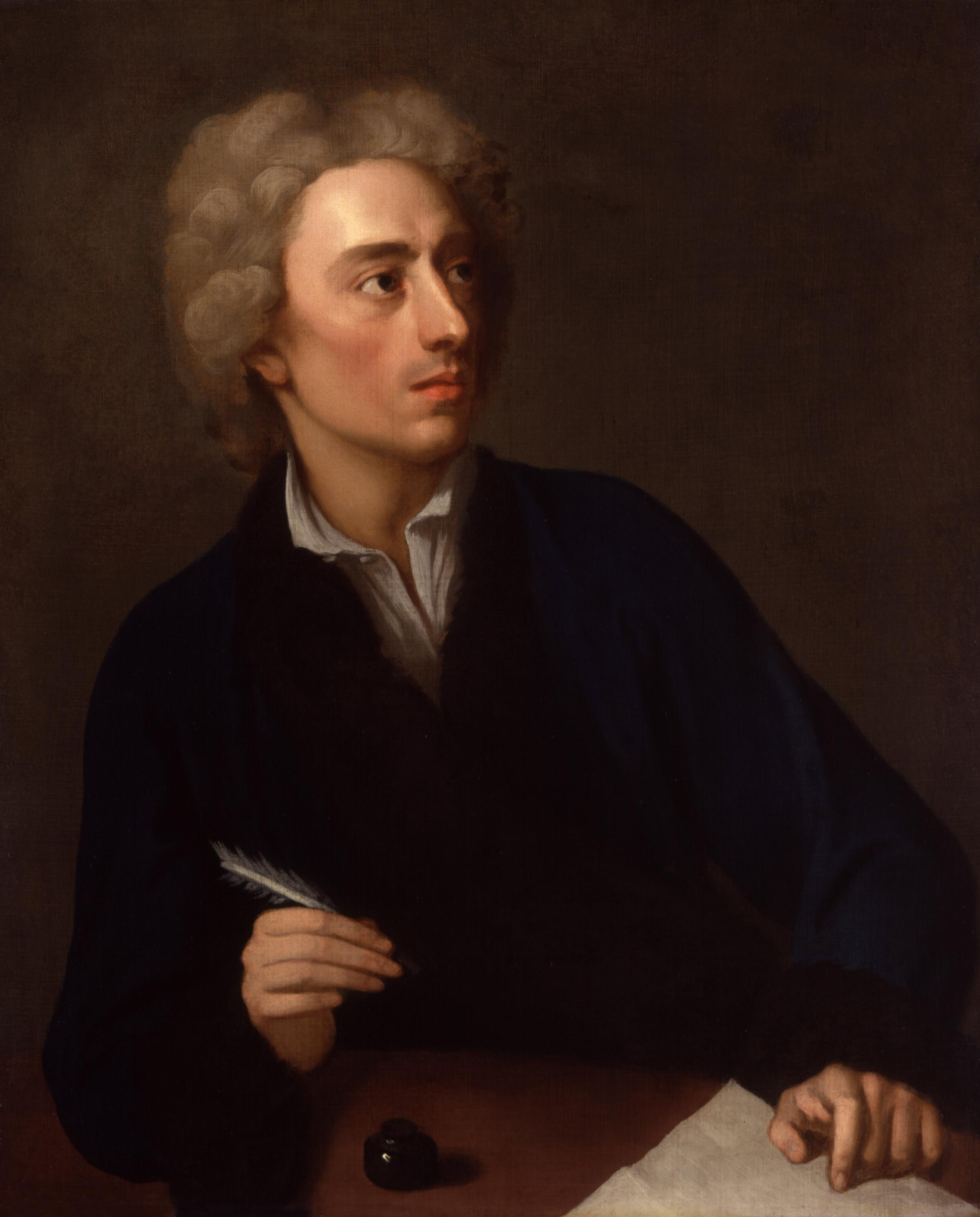
Alexander Pope nejznámější citáty
Alexander Pope: Citáty o lidech
„Historie je spíš plná příkladů věrnosti psů než lidí.“
Varianta: Historie je spíše plná příkladů věrnosti psů než přátel.
Alexander Pope citáty a výroky
„Člověk bývá tak sebevědomý, jak je omezeno jeho chápání.“
Varianta: Člověk bývá tak sebevědomí, jak je omezeno jeho chápání.
„Společnost je šílenství mnoha, aby jen pár z nás trpělo.“
Originál: (en) Party is the madness of many, for the gain of a few.
Zdroj: [Pope, Alexander, 1822, The works of Alexander Pope, Svazek 6, Printed for R. Priestley, 381, angličtina]
Alexander Pope: Citáty anglicky
“They dream in Courtship, but in Wedlock wake.”
"The Wife of Bath her Prologue, from Chaucer" (c.1704, published 1713), line 103.
Odes, Book iv, Ode 9, reported in William Warburton, The Works of Alexander Pope, Esq (1751) p. 31.
Thoughts on Various Subjects (1727)
“Ignobly vain, and impotently great.”
Zdroj: Prologue to Mr. Addison's Cato (1713), Line 29.
As quoted in Observations, Anecdotes, and Characters, of Books and Men (1820) by Joseph Spence [arranged, with notes, by the late Edmund Malone], pp. 28–29 & 53–54.
Attributed
“Not louder shrieks to pitying heav'n are cast,
When husbands, or when lapdogs, breathe their last.”
Alexander Pope The Rape of the Lock
Canto III, line 157.
The Rape of the Lock (1712, revised 1714 and 1717)
In a 1715 letter (LXXVII), as found in Letters of Mr. Alexander Pope: And Several of His Friends. 1737.
George Dennison Prentice http://www.picturehistory.com/product/id/4820, in Prenticeana (1860) <br class="br">Misattributed
“Who ne'er knew joy but friendship might divide,
Or gave his father grief but when he died.”
"Epitaph on the Hon. S. Harcourt" (1720).
“Proud Nimrod first the bloody chase began
A mighty hunter, and his prey was man.”
Alexander Pope kniha Windsor Forest
Zdroj: Windsor Forest (1713), Line 61.
“From old Belerium to the northern main.”
Alexander Pope kniha Windsor Forest
Zdroj: Windsor Forest (1713), Line 316.
“Fair tresses man's imperial race ensnare,
And beauty draws us with a single hair.”
Alexander Pope The Rape of the Lock
Canto II, line 27. Compare: "No cord nor cable can so forcibly draw, or hold so fast, as love can do with a twined thread", Robert Burton, Anatomy of Melancholy, Part iii, Section 2, Membrane 1, Subsection 2.
The Rape of the Lock (1712, revised 1714 and 1717)
“Never find fault with the absent.”
Absenti nemo non nocuisse velit.
Sextus Propertius, Elegies, II, xix, 32, also translated: "Let no one be willing to speak ill of the absent".
Misattributed
“If to her share some female errors fall,
Look on her face, and you'll forget 'em all.”
Alexander Pope The Rape of the Lock
Canto II, line 17.
The Rape of the Lock (1712, revised 1714 and 1717)
Zdroj: The Temple of Fame (1711), Lines 468-472.
Alexander Pope The Rape of the Lock
Canto II, line 105.
The Rape of the Lock (1712, revised 1714 and 1717)
“Coffee, which makes the politician wise,
And see through all things with his half-shut eyes.”
Alexander Pope The Rape of the Lock
Canto III, line 117.
The Rape of the Lock (1712, revised 1714 and 1717)
“The hidden harmony is better than the obvious.”
Heraclitus, Fragments, 54; http://philoctetes.free.fr/heraclitefraneng.htm and http://www.wsu.edu/~dee/GREECE/HERAC.HTM; also translated in such variants as:<br>The unapparent connection is more powerful than the apparent one<br>The hidden harmony is better than the open one. <br class="br">Misattributed
“Let such, such only tread this sacred floor,
Who dare to love their country and be poor.”
Inscription on the entrance to his grotto in Twickenham, published in "Verses on a Grotto by the River Thames at Twickenham, composed of Marbles, Spars and Minerals", line 14, (written 1740, published 1741); also quoted as "Who dared to love their country, and be poor."
“You beat your pate, and fancy wit will come;
Knock as you please, there's nobody at home.”
Credited as Epigram: An Empty House (1727), or On a Dull Writer; alternately attributed to Jonathan Swift in John Hawkesworth, The Works of Jonathan Swift, D.D., Dean of St. Patrick's, Dublin (1754), p. 265. Compare: "His wit invites you by his looks to come, But when you knock, it never is at home", William Cowper, Conversation, line 303.
Misattributed
“Ambition first sprung from your blest abodes;
The glorious fault of Angels and of Gods.”
Zdroj: The Works of Mr. Alexander Pope (1717), Elegy to the Memory of an Unfortunate Lady, Line 13.
Stanza 1.
The Universal Prayer (1738)
Zdroj: Prologue to Mr. Addison's Cato (1713), Line 21. Pope also uses the reference, "Like Cato, give his little Senate laws", in his Epistle to Dr. Arbuthnot (1734), Prologue to Imitations of Horace.
Le génie enfante, le goût conserve. Le goût est le bon sens du génie; sans le goût, le génie n'est qu'une sublime folie. <br class="br">François-René de Chateaubriand, in "Essai sur la littérature anglaise (1836): Modèles classiques http://visualiseur.bnf.fr/CadresFenetre?O=NUMM-101390&M=tdm. <br class="br">Misattributed
“The mouse that always trusts to one poor hole
Can never be a mouse of any soul.”
"The Wife of Bath her Prologue, from Chaucer" (c.1704, published 1713), lines 298-299. Compare: "I hold a mouses wit not worth a leke, That hath but on hole for to sterten to", Geoffrey Chaucer, Canterbury Tales, "The Wif of Bathes Prologue", line 6154; "The mouse that hath but one hole is quickly taken", George Herbert, Jacula Prudentum.
Stanza 10; this extends upon the theme evident in the lines of Edmund Spenser in The Faerie Queene (1596), Book V, Canto ii, Stanza 42: "Who will not mercie unto others show, How can he mercy ever hope to have?"
The Universal Prayer (1738)


