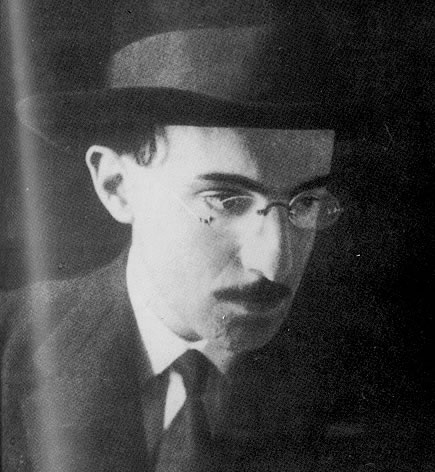
Fernando Pessoa nejznámější citáty
Fernando Pessoa: Citáty o životě
Fernando Pessoa: Citáty o lásce
Fernando Pessoa citáty a výroky
„Co vidíme, není to, co vidíme, ale to, co jsme.“
Zdroj: [Danchev, Alex, 2006, Georges Braque, BB art, 80-7341-942-4]
„Všichni víme, že zemřeme, všichni cítíme, že nezemřeme.“
Zdroj: https://vltava.rozhlas.cz/prekvapive-realny-pribeh-o-zapasu-dobra-a-zla-novy-roman-markety-pilatove-hraje-8422982
Fernando Pessoa: Citáty anglicky
“The slope takes you to the windmill, but effort takes you nowhere.”
Fernando Pessoa kniha The Book of Disquiet
Ibid., p. 171
The Book of Disquiet
Originál: A ladeira leva ao moinho, mas o esforço não leva a nada.
Vem sentar-te comigo, Lídia, à beira do rio.
Sossegadamente fitemos o seu curso e aprendamos
Que a vida passa, e não estamos de mãos enlaçadas.
(Enlacemos as mãos)
.....
Desenlacemos as mãos, porque não vale a pena cansarmo-nos.
Quer gozemos, quer não gozemos, passamos como o rio.
Mais vale saber passar silenciosamente
E sem desassossegos grandes.
Ricardo Reis (heteronym), ode translated by Peter Rickard.
“Yes, talking to people makes me sleepy.”
Fernando Pessoa kniha The Book of Disquiet
Ibid.
The Book of Disquiet
Originál: Sim, falar com gente dá-me vontade de dormir.
“Ah, to be you while being I!
To have your glad unconsciousness
And be conscious of it!”
Ah, poder ser tu, sendo eu!
Ter a tua alegre inconsciência,
E a consciência disso!
"Ela canta, pobre ceifeira" ["She sings, poor reaper"], first published in Athena, no. 3 (December 1924); trans. Richard Zenith, A Little Larger Than the Entire Universe (Penguin, 2006)
“Against destiny I fulfilled my duty.
Uselessly? No, for I fulfilled it.”
Fernando Pessoa kniha Mensagem
Poem "D. Duarte", verses 5-6
Message
Originál: Cumpri contra o Destino o meu dever.
Inutilmente? Não, porque o cumpri.
Fernando Pessoa kniha The Book of Disquiet
Ibid., p. 133
[X]: text missing in the manuscript.
The Book of Disquiet
Originál: Contentar-se com o que lhe dão é próprio dos escravos. Pedir masi é próprio das crianças. Conquistar mais é próprio dos loucos [porque toda a conquista é [X]]
“Changing from the ghosts of faith to the spectres of reason is just changing cells.”
Fernando Pessoa kniha The Book of Disquiet
Ibid.
The Book of Disquiet
Originál: Passar dos fantasmas da fé para os espectros da razão é somente ser mudado de cela.
Fernando Pessoa kniha The Book of Disquiet
Ibid., p. 279
The Book of Disquiet
Originál: Porque é bela a arte? Porque é inútil. Porque é feia a vida? Porque é toda fins e propósitos e intenções.
Sejamos simples e calmos,
Como os regatos e as árvores,
E Deus amar-nos-á fazendo de nós
Belos como as árvores e os regatos,
E dar-nos-á verdor na sua primavera,
E um rio aonde ir ter quando acabemos...
E não nos dará mais nada, porque dar-nos mais seria tirar-nos mais.
Alberto Caeiro (heteronym), O Guardador de Rebanhos ("The Keeper of Sheep"), VI — in A Little Larger Than the Entire Universe, trans. Richard Zenith (Penguin, 2006)
“What is art but the denial of life?”
Fernando Pessoa kniha The Book of Disquiet
Ibid., p. 174
The Book of Disquiet
Originál: Que é a arte senão a negação da vida?
“That's not my love; that's just your life.”
Fernando Pessoa kniha The Book of Disquiet
Ibid.
The Book of Disquiet
Originál: Isso não é o meu amor; é apenas a sua vida.
“There is no safe standard to tell man from animals.”
Fernando Pessoa kniha The Book of Disquiet
Ibid., p. 150
The Book of Disquiet
Originál: Não há critério seguro para distinguir o homem dos animais.
Fernando Pessoa kniha The Book of Disquiet
Ibid., p. 258
The Book of Disquiet
Originál: O mundo é de quem não sente. A condição essencial para se ser um homem prático é a ausência de sensibilidade.
Fernando Pessoa kniha The Book of Disquiet
Ibid.
The Book of Disquiet
Originál: Eu, porém, não tenho nobreza estilística. Dói-me a cabeça porque me dói a cabeça. Dói-me o universo porque me dói a cabeça.
“Who am I to myself? Just a feeling of mine.”
Fernando Pessoa kniha The Book of Disquiet
Ibid., p. 156
The Book of Disquiet
Originál: Quem sou eu para mim? Só uma sensação minha.
Fernando Pessoa kniha The Book of Disquiet
Ibid.
The Book of Disquiet
Originál: O humanitarismo é uma grosseria.
Varianta: Enthusiasm is rude.
“I never meant to be but a dreamer.”
Fernando Pessoa kniha The Book of Disquiet
Ibid.
The Book of Disquiet
Originál: Nunca pretendi ser senão um sonhador.
“My dreams are a stupid refuge, like an umbrella against a thunderbolt.”
Fernando Pessoa kniha The Book of Disquiet
Ibid., p. 101
The Book of Disquiet
Originál: Os meus sonhos são um refúgio estúpido, como um guarda-chuva contra um raio.
Fernando Pessoa kniha The Book of Disquiet
Ibid., p. 53
The Book of Disquiet
Originál: A fraternidade tem subtilezas.
“It was just a moment, and I saw myself. Then I no longer could say what I was.”
Fernando Pessoa kniha The Book of Disquiet
Ibid., p. 66
The Book of Disquiet
Originál: Foi só um momento, e vi-me. Depois já não sei sequer dizer o que fui.
Fernando Pessoa kniha The Book of Disquiet
Ibid., p. 150
The Book of Disquiet
Originál: O homem perfeito do pagão era a perfeição do homem que há; o homem perfeito do cristão a perfeição do homem que não há; o homem perfeito do budista a perfeição de não haver homem.
“For I am the size of what I see
not my height's size.”
Fernando Pessoa kniha The Book of Disquiet
Attributed to the Caeiro alter ego, in A Factless Autobiography, Richard Zenith Edition, Lisbon, 2006, p. 71
The Book of Disquiet
Originál: Porque eu sou do tamanho do que vejo
e não do tamanho da minha altura.
“My heart is a little larger than the entire universe.”
O meu coração é um pouco maior que o universo inteiro.
"Saí do comboio" (4 July 1934), trans. Richard Zenith.
“To stagnate in the sun, goldenly, like an obscure lake surrounded by flowers.”
Fernando Pessoa kniha The Book of Disquiet
On a strictly intellectual life.
A Factless Autobiography, Richard Zenith Edition, Lisbon, 2006, p. 70
The Book of Disquiet
Originál: Estagnar ao sol, douradamente, como um lago obscuro rodeado de flores.
“My joy is as painful as my pain.”
Fernando Pessoa kniha The Book of Disquiet
Ibid., p. 100
The Book of Disquiet
Originál: A minha alegria é tão dolorosa como a minha dor.
“Irony is the first hint that consciousness became conscious.”
Fernando Pessoa kniha The Book of Disquiet
Ibid., p. 151
The Book of Disquiet
Originál: A ironia é o primeiro indício de que a consciência se tornou consciente.
Fernando Pessoa kniha The Education Of the Stoic
The Education of the Stoic: The Only Manuscript of the Baron of Teive, Exact Change, Cambridge, 2005, p. 5
The Education of the Stoic
Fernando Pessoa kniha The Book of Disquiet
Ibid., p. 238
The Book of Disquiet
Originál: O olfacto é uma vista estranha. Evoca paisagens sentimentais por um desenhar súbito do subconsciente.
“To narrate is to create, for living is just being lived.”
Fernando Pessoa kniha The Book of Disquiet
Ibid.
The Book of Disquiet
Originál: Narrar é criar, pois viver é apenas ser vivido.
Fernando Pessoa kniha The Book of Disquiet
Ibid., p. 50
The Book of Disquiet
Originál: Um tédio que inclui a antecipação só de mais tédio; a pena, já, de amanhã ter pena de ter tido pena hoje.


