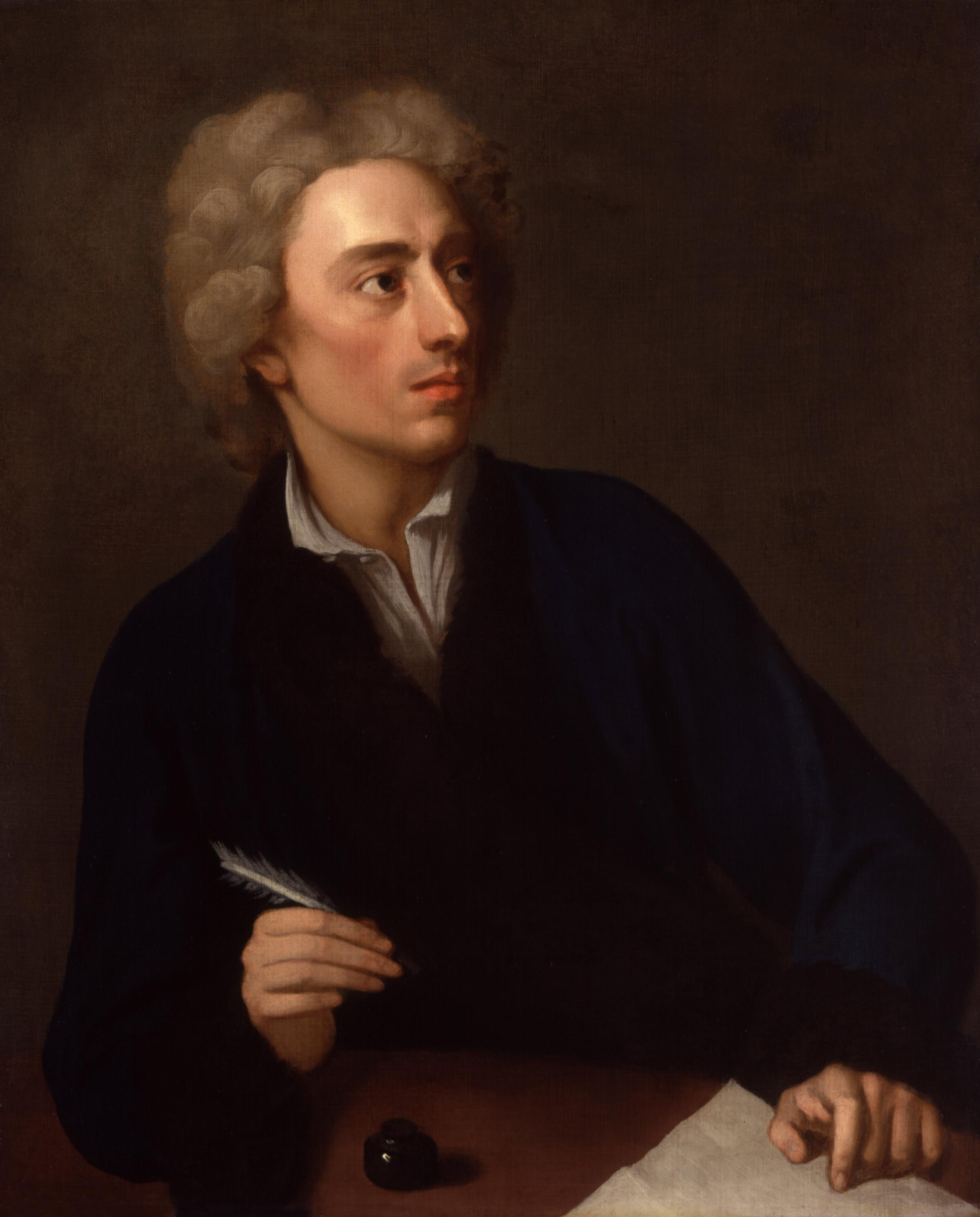
Alexander Pope nejznámější citáty
Alexander Pope: Citáty o lidech
„Historie je spíš plná příkladů věrnosti psů než lidí.“
Varianta: Historie je spíše plná příkladů věrnosti psů než přátel.
Alexander Pope citáty a výroky
„Člověk bývá tak sebevědomý, jak je omezeno jeho chápání.“
Varianta: Člověk bývá tak sebevědomí, jak je omezeno jeho chápání.
„Společnost je šílenství mnoha, aby jen pár z nás trpělo.“
Originál: (en) Party is the madness of many, for the gain of a few.
Zdroj: [Pope, Alexander, 1822, The works of Alexander Pope, Svazek 6, Printed for R. Priestley, 381, angličtina]
Alexander Pope: Citáty anglicky
“A work of art that contains theories is like an object on which the price tag has been left.”
Une oeuvre où il y a des théories est comme un objet sur lequel on laisse la marque du prix. <br class="br">Marcel Proust, In Search of Lost Time, part VII: Time Regained, chapter III, "An Afternoon Party at the House of the Princesse de Guermantes" ( French version http://web.archive.org/web/20010708070436/http://gallica.bnf.fr/proust/TempsRetrouve.htm and English translation http://etext.library.adelaide.edu.au/p/proust/marcel/p96t/chapter3.html). <br class="br">Misattributed
“Of Manners gentle, of Affections mild;
In Wit, a Man; Simplicity, a Child.”
"Epitaph on Gay" (1733), lines 1-2. Reported in The Poems of Alexander Pope, ed. John Butt, sixth edition (Yale University Press, 1970), p. 818. Compare: "Her wit was more than man, her innocence a child", John Dryden, Elegy on Mrs. Killegrew, line 70.
“Absent or dead, still let a friend be dear.”
"Epistle to Robert, Earl of Oxford and Mortimer" (1721).
“The garlands fade, the vows are worn away;
So dies her love, and so my hopes decay.”
Alexander Pope Pastorals
Autumn, line 70.
Pastorals (1709)
“Tell me, my soul, can this be death?”
The Dying Christian to His Soul (1712)
Preface.
The Works of Mr. Alexander Pope (1717)
Zdroj: The Works of Mr. Alexander Pope (1717), Elegy to the Memory of an Unfortunate Lady, Line 6.
“Such were the notes thy once lov'd poet sung,
Till death untimely stopp'd his tuneful tongue.”
"Epistle to Robert, Earl of Oxford and Mortimer" preface to Thomas Parnell's Poems on Several Occasions (1721).
“What beck'ning ghost, along the moonlight shade
Invites my steps, and points to yonder glade?”
Zdroj: The Works of Mr. Alexander Pope (1717), Elegy to the Memory of an Unfortunate Lady, Line 1. Compare: "What gentle ghost, besprent with April dew, Hails me so solemnly to yonder yew?", Ben Jonson, Elegy on the Lady Jane Pawlet.
Thoughts on Various Subjects (1727)
“And binding Nature fast in fate,
Left free the human will.”
Stanza 3.
The Universal Prayer (1738)
“Nor Fame I slight, nor for her favors call;
She comes unlooked for, if she comes at all.”
Zdroj: The Temple of Fame (1711), Line 513.
the last two lines are a quote of 1 Corinthians 15:55 http://en.wikisource.org/wiki/Bible_(King_James)/1_Corinthians#15:55. <br class="br">The Dying Christian to His Soul (1712)
“But when mischief mortals bend their will,
How soon they find fit instruments of ill!”
Alexander Pope The Rape of the Lock
Canto III, line 125.
The Rape of the Lock (1712, revised 1714 and 1717)
“Passions…are the gales of life…”
As quoted by Henry St John, 1st Viscount Bolingbroke in a letter to Jonathan Swift (29 March 1730).
Attributed
“This is the Jew
That Shakespeare drew.”
As quoted in various reports, including Charles Wells Moulton, The Library of Literary Criticism of English and American Authors (1901), p. 342; William Dunlap, The Life of George Frederick Cooke (1815), p. 26 (quoting an apparently contemporaneous journal account by the subject). Bartlett's Quotations, 10th edition (1919), reports that on the 14th of February, 1741, Macklin established his fame as an actor in the character of Shylock, in the "Merchant of Venice". Macklin's performance of this character so forcibly struck a gentleman in the pit that he, as it were involuntarily, exclaimed,—
“This is the Jew
That Shakespeare drew!”
It has been said that this gentleman was Mr. Pope, and that he meant his panegyric on Macklin as a satire against Lord Lansdowne", Biographia Dramatica, vol. i. part II. p. 469.
Attributed
“Party is the madness of many, for the gain of a few.”
From Roscoe's edition of Pope, vol. v. p. 376; originally printed in Motte's Miscellanies (1727). In the edition of 1736 Pope says, "I must own that the prose part (the Thought on Various Subjects), at the end of the second volume, was wholly mine. January, 1734".
Thoughts on Various Subjects (1727)
Zdroj: The Works of Mr. Alexander Pope (1717), Elegy to the Memory of an Unfortunate Lady, Line 71.
Alexander Pope The Rape of the Lock
Canto III, line 153.
The Rape of the Lock (1712, revised 1714 and 1717)
Edward Young, "Night Thoughts," (1742-1745) Part IX http://www.litgothic.com/Texts/young_night_thoughts.pdf. <br class="br">Misattributed
“Ye Gods! annihilate but space and time,
And make two lovers happy.”
Martinus Scriblerus on the Art of Sinking in Poetry, Chap. xi, reported in William Warburton, The Works of Alexander Pope, Esq (1751) p. 196.
“Hark! they whisper; angels say,
Sister spirit, come away!”
The Dying Christian to His Soul (1712)
“Here am I, dying of a hundred good symptoms.”
Pope's reply when told by his physician that he was better, on the morning of his death (30 May 1744), as quoted by Owen Ruffhead in The Life of Alexander Pope; With a Critical Essay on His Writings and Genius (1769), p. 475.
“Sir Plume, of amber snuff-box justly vain,
And the nice conduct of a clouded cane.”
Alexander Pope The Rape of the Lock
Canto IV, line 123.
The Rape of the Lock (1712, revised 1714 and 1717)
Spence's Anecdotes and The Guardian (21 May 1713); as quoted in The Ethics of Diet: A Catena of Authorities Deprecatory of the Practice of Flesh-eating https://archive.org/stream/ethicsofdietcate00will/ethicsofdietcate00will#page/n3/mode/2up by Howard Williams (London: F. Pitman, 1883), p. 132.
“The most positive men are the most credulous…”
Thoughts on Various Subjects (1727)
Samuel Rogers, in The Pleasures of Memory (1792), Part http://www.gutenberg.org/files/13586/. <br class="br">Misattributed
“Just as the twig is bent, the tree's inclined.”
Alexander Pope Moral Essays
Epistle I, To Lord Cobham (1734), line 150
Moral Essays (1731–1735)


