„Prostor je nekonečný co do rozlohy, není však donekonečna dělitelný.“
Zdroj: [1999, Velké postavy západního myšlení, 54, 80-7260-002-8]
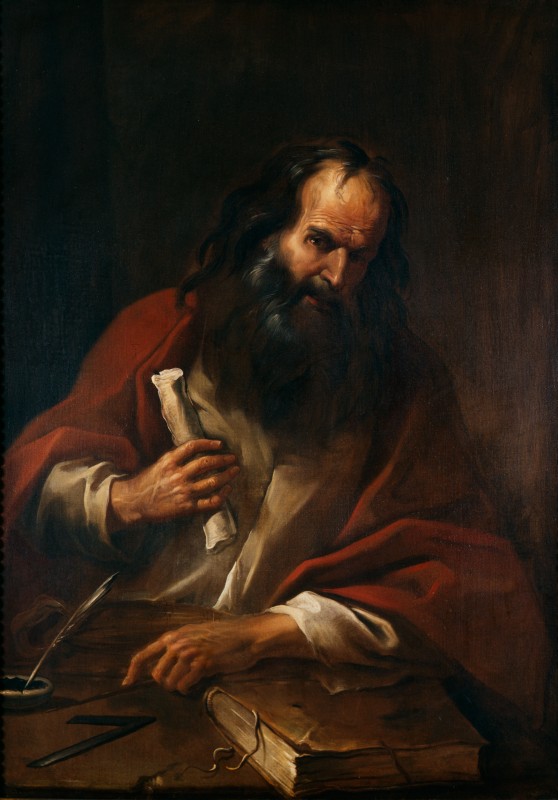
Eukleidés též Euklides nebo Euklid byl řecký matematik a geometr. Většinu života strávil v Alexandrii v Egyptě. Wikipedia
„Prostor je nekonečný co do rozlohy, není však donekonečna dělitelný.“
Zdroj: [1999, Velké postavy západního myšlení, 54, 80-7260-002-8]
“There is no royal road to geometry.”
Non est regia ad Geometriam via.
μὴ εἶναι βασιλικὴν ἀτραπὸν ἐπί γεωμετρίαν, Non est regia [inquit Euclides] ad Geometriam via <br class="br">Reply given when the ruler Ptolemy I Soter asked Euclid if there was a shorter road to learning geometry than through Euclid's Elements.The "Royal Road" was the road built across Anatolia and Persia by Darius I which allowed rapid communication and troop movement, but use of ἀτραπός (rather than ὁδός) conveys the connotation of "short cut". <br class="br">The Greek is from Proclus (412–485 AD) in Commentary on the First Book of Euclid's Elements, the Latin translation is by Francesco Barozzi, 1560) the English translation follows Glenn R. Morrow (1970), p. 57 http://books.google.com/books?id=JZEHj2fEmqAC&q=royal#v=snippet&q=royal&f=false. <br class="br">Attributed
“The laws of nature are but the mathematical thoughts of God.”
The earliest published source found on google books that attributes this to Euclid is A Mathematical Journey by Stanley Gudder (1994), p. xv http://books.google.com/books?id=UiOxd2-lfGsC&q=%22mathematical+thoughts%22+euclid#search_anchor. However, many earlier works attribute it to Johannes Kepler, the earliest located being in the piece "The Mathematics of Elementary Chemistry" by Principal J. McIntosh of Fowler Union High School in California, which appeared in School Science and Mathematics, Volume VII ( 1907 http://books.google.com/books?id=kAEUAAAAIAAJ&pg=PR3#v=onepage&q&f=false), p. 383 http://books.google.com/books?id=kAEUAAAAIAAJ&pg=PA383#v=onepage&q&f=false. Neither this nor any other source located gives a source in Kepler's writings, however, and in an earlier source, the 1888 Notes and Queries, Vol V., it is attributed on p. 165 http://books.google.com/books?id=0qYXAQAAMAAJ&pg=PA165#v=onepage&q&f=false to Plato. It could possibly be a paraphrase of either or both of the following to comments in Kepler's 1618 book Harmonices Mundi (The Harmony of the World)': "Geometry is one and eternal shining in the mind of God" and "Since geometry is co-eternal with the divine mind before the birth of things, God himself served as his own model in creating the world". <br class="br">Misattributed
“Give him threepence, since he must make gain out of what he learns.”
Said to be a remark made to his servant when a student asked what he would get out of studying geometry. <br class="br">'threepence' renders τριώβολον "three-obol-piece". This amount increases the sarcasm of Euclid's reply, as it was the standard fee of a Dikastes for attending a court case (μίσθος δικαστικός), thus inverting the role of teacher and pupil to that of accused and juror. <br class="br">The English translation is by The History of Greek Mathematics by Thomas Little Heath (1921), p. 357 http://books.google.com/books?id=h4JsAAAAMAAJ&pg=PA357#v=onepage&q&f=false. The quote is recorded by Stobaeus' Florilegium iv, 114 ( ed. Teubner 1856 http://www.archive.org/stream/iohannisstobaei00meingoog#page/n598/mode/2up, p. 205; see also here http://laudatortemporisacti.blogspot.ch/2011/04/anecdote-about-euclid.html). Stobaeus attributes the anecdote to Serenus. <br class="br">Attributed
Euclid kniha Elements
Elements, Book I, Proposition 4.
Latin translation: Quod erat demonstrandum (often abbreviated Q.E.D.).
Euclid’s Elements
“And the whole [is] greater than the part.”
Euclid kniha Elements
Καὶ τὸ ὅλον τοῦ μέρους μεῖζον
ἐστιν
Elements, Book I, Common Notion 8 (5 in certain editions)
Cf. Aristotle, Metaphysics, Book Η 1045a 8–10: "… the totality is not, as it were, a mere heap, but the whole is something besides the parts … [πάντων γὰρ ὅσα πλείω μέρη ἔχει καὶ μὴ ἔστιν οἷον σωρὸς τὸ πᾶν]"
Euclid’s Elements
“A prime number is one (which is) measured by a unit alone.”
Euclid kniha Elements
Elements, Book 7, Definition 11 (12 in certain editions)
Euclid’s Elements


