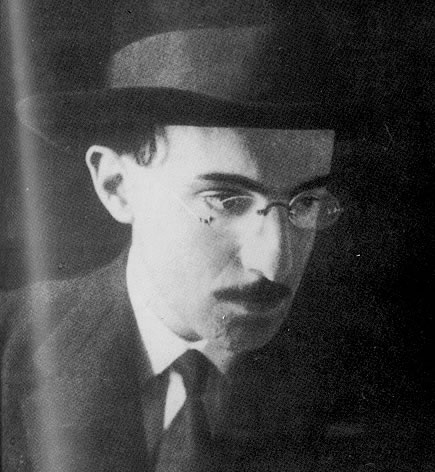
Fernando Pessoa nejznámější citáty
Fernando Pessoa: Citáty o životě
Fernando Pessoa: Citáty o lásce
Fernando Pessoa citáty a výroky
„Co vidíme, není to, co vidíme, ale to, co jsme.“
Zdroj: [Danchev, Alex, 2006, Georges Braque, BB art, 80-7341-942-4]
„Všichni víme, že zemřeme, všichni cítíme, že nezemřeme.“
Zdroj: https://vltava.rozhlas.cz/prekvapive-realny-pribeh-o-zapasu-dobra-a-zla-novy-roman-markety-pilatove-hraje-8422982
Fernando Pessoa: Citáty anglicky
Fernando Pessoa kniha The Education Of the Stoic
Ibid., p. 9
The Education of the Stoic
Fernando Pessoa kniha The Book of Disquiet
A Factless Autobiography, number 424, trans. Richard Zenith, Penguin Classics edition
The Book of Disquiet
Fernando Pessoa kniha The Book of Disquiet
Os Grandes Trechos, s/n. Translated from the Portuguese Richard Zenith Edition, Lisbon, 2006
The Book of Disquiet
Originál: E então vem-me o desejo transbordante, absurdo, de uma espécie de satanismo que precedeu Satã, de que um dia [...] se encontre uma fuga para fora de Deus e o mais profundo de nós deixe, não sei como, de fazer parte do ser ou do não ser.
O poeta é um fingidor.
Finge tão completamente
Que chega a fingir que é dor
A dor que deveras sente.
"Autopsicografia" ["Autopsychography"], in Presença, No. 36 (November 1932)
Fernando Pessoa's most translated poem.
Richard Zenith's translation:
The poet is a faker
Who's so good at his act
He even fakes the pain
Of pain he feels in fact.
“Metaphysics is a consequence of not feeling very well.”
A metafísica é uma consequência de estar mal disposto.
Tabacaria (1928), trans. Richard Zenith
Fernando Pessoa kniha The Book of Disquiet
Ibid., p. 98
The Book of Disquiet
Originál: Há sensações que são sonos, que ocupam como uma névoa toda a extensão do espírito, que não deixam pensar, que não deixam agir, que não deixam claramente ser.
<p>A morte é a curva da estrada,
Morrer é só não ser visto.
Se escuto, eu te oiço a passada
Existir como eu existo.</p><p>A terra é feita de céu.
A mentira não tem ninho.
Nunca ninguém se perdeu.
Tudo é verdade e caminho.</p>
"A morte é a curva da estrada" (23 May 1932), in A Little Larger Than the Entire Universe, trans. Richard Zenith (Penguin, 2006)
“My curiosity sister of larks.”
Fernando Pessoa kniha The Book of Disquiet
Ibid., p. 219
The Book of Disquiet
Originál: A minha curiosidade irmã das cotovias
“Thing thrown to a corner, rag fallen on the road, my ignoble being feigns itself in front of life.”
Fernando Pessoa kniha The Book of Disquiet
Ibid., p. 64
The Book of Disquiet
Originál: Coisa arrojada a um canto, trapo caído na estrada, meu ser ignóbil ante a vida finge-se.
“I believe that saying a thing is to keep its virtues and take away its terror.”
Fernando Pessoa kniha The Book of Disquiet
Ibid., p. 55
The Book of Disquiet
Originál: Creio que dizer uma coisa é conservar-lhe a virtude e tirar-lhe o terror.
Fernando Pessoa kniha The Book of Disquiet
Ibid.
The Book of Disquiet
Originál: Trazem-me a fé como um embrulho fechado numa salva alheia. Querem que o aceite para que não o abra.
“Freedom is the possibility of isolation… If you can't live alone, you were born a slave.”
A liberdade é a possibilidade do isolamento... Se te é impossível viver só, nasceste escravo.
The Book of Disquietude, trans. Richard Zenith, text 283
“My head and the universe ache me.”
Fernando Pessoa kniha The Book of Disquiet
Ibid.
The Book of Disquiet
Originál: Doem-me a cabeça e o universo.
“All beginnings are involuntary.”
Fernando Pessoa kniha Mensagem
Poem "O Conde D. Henrique", verse 1
Message
Originál: Todo começo é involuntário.
“Art consists in making others feel what we feel.”
Fernando Pessoa kniha The Book of Disquiet
Ibid., p. 231
The Book of Disquiet
Originál: A arte consiste em fazer os outros sentir o que nós sentimos.
“Given that we cannot know all the elements in a problem, we never can solve it.”
Fernando Pessoa kniha The Book of Disquiet
Ibid., p. 282
The Book of Disquiet
Originál: Como nunca podemos conhecer todos os elementos de uma questão, nunca a podemos resolver.
“Oh salty sea, how much of your salt
are tears of Portugal!”
Fernando Pessoa kniha Mensagem
Poem "Mar Português", Verses 1-2
Message
Originál: Ó mar salgado, quanto do teu sal
São lágrimas de Portugal!
Fernando Pessoa kniha The Book of Disquiet
Ibid., p. 164
The Book of Disquiet
Originál: Nunca me pesou o que de trágico se passasse na China. É decoração longínqua, ainda que a sangue e peste.
“Everything was asleep as if the universe was a mistake.”
Fernando Pessoa kniha The Book of Disquiet
Ibid., p. 60
The Book of Disquiet
Originál: Dormia tudo como se o universo fosse um erro.
Fernando Pessoa kniha The Book of Disquiet
Ibid., p. 271
a possible play on Tertullian's: "credo quia absurdum" (I believe because it's absurd), "credo quia impossibilis est" (I believe because it's impossible).
Richard Zenith translates boémio as bohemian, not bon vivant.
The Book of Disquiet
Originál: Nunca fui mais que um boémio isolado, o que é um absurdo; ou um boémio místico, o que é uma coisa impossível.
Fernando Pessoa kniha Mensagem
<p>Original: Triste de quem vive em casa,<br>Contente com o seu lar,<br>Sem que um sonho, no erguer de asa,<br>Faça até mais rubra a brasa<br>Da lareira a abandonar!</p><p>Triste de quem é feliz!<br>Vive porque a vida dura.<br>Nada na alma lhe diz<br>Mais que a lição da raiz-<br>Ter por vida a sepultura.</p> <br class="br">Poem "O Quinto Império" http://www.inverso.pt/Mensagem/Encoberto/QuintoImperio.htm, lines 1–10 <br class="br">Message
“My homeland is the portuguese language.”
Fernando Pessoa kniha The Book of Disquiet
Ibid., p. 230
Translation variants:
My fatherland is the Portuguese language.
My nation is the Portuguese language.
My country is the Portuguese language.
My home is the Portuguese language.
The Book of Disquiet
Originál: Minha Pátria é a língua portuguesa.
Fernando Pessoa kniha The Book of Disquiet
Ibid.
The Book of Disquiet
Originál: Pensar é destruir. O próprio processo do pensamento o indica para o mesmo pensamento, porque pensar é decompor.
“Art lies because it's social.”
Fernando Pessoa kniha The Book of Disquiet
Ibid., p. 232
The Book of Disquiet
Originál: A arte mente porque é social
Fernando Pessoa kniha The Education Of the Stoic
Ibid., p. 18.
The Education of the Stoic
Fernando Pessoa kniha The Education Of the Stoic
Ibid.
The Education of the Stoic
Fernando Pessoa kniha The Education Of the Stoic
Ibid., p. 14
The Education of the Stoic
Começo a conhecer-me. Não existo.
Sou o intervalo entre o que desejo ser e os outros me fizeram.
Álvaro de Campos (heteronym), "Começo a conhecer-me. Não existo.", in Fernando Pessoa & Co: Selected Poems, trans. Richard Zenith (Grove Press, 1998)
“The sea is fulfilled, and the Empire fell apart.
Lord, Portugal must yet fulfill itself!”
Fernando Pessoa kniha Mensagem
Poem "O Infante", verses 11-12
Message
Originál: Cumpriu-se o Mar, e o Império se desfez.
Senhor, falta cumprir-se Portugal!
“Liberty is the possibility of isolation.”
Fernando Pessoa kniha The Book of Disquiet
Ibid., p. 246
The Book of Disquiet
Originál: A liberdade é a possibilidade do isolamento.


